Propstore · Sale 505 · Lot 197
Indiana Jones' Screen-Matched Fedora and Shirt Worn by Vic Armstrong - INDIANA JONES AND THE TEMPLE OF DOOM (1984)/INDIANA JONES AND THE LAST CRUSADE (1989)
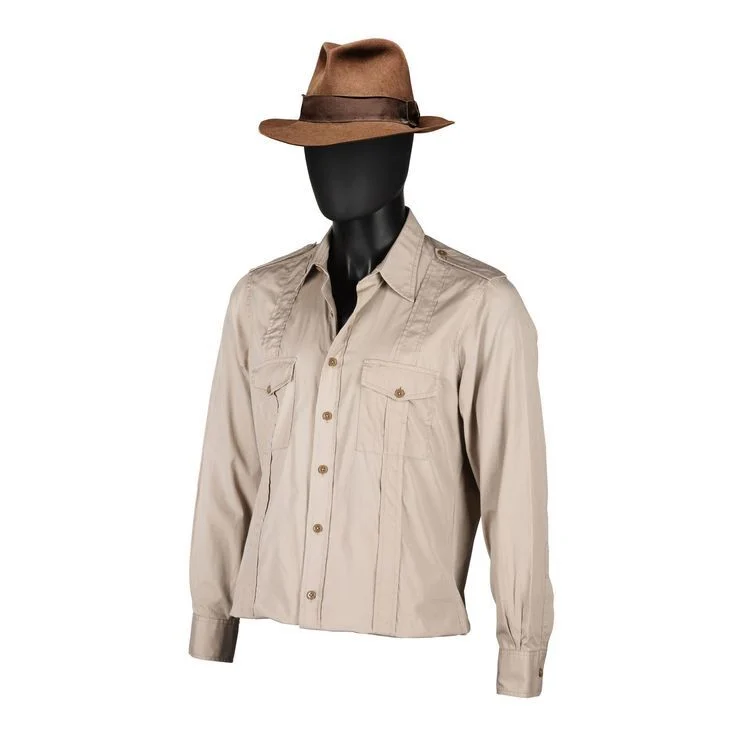
Photographs: © Propstore
View this listing in the catalog PDF
Bidding for this lot will end on Friday, December 4th. Lots will begin closing at 3:00PM GMT / 10:00AM EST / 7:00AM PST. Please note, other lots may close on Saturday, December 5th or Sunday, December 6th
Indiana Jones’ screen-matched fedora and shirt worn by primary stunt double Vic Armstrong in Steven Spielberg’s action-adventure sequel Indiana Jones and the Temple of Doom, and likely worn in Indiana Jones and the Last Crusade.
The fedora was made specifically for The Temple of Doom and screen-matches to the sequence in which Indiana Jones, Willie Scott (Kate Capshaw) and Short Round (Ke Huy Quan) become trapped beneath a descending spiked ceiling. Distinctive creases in the ribbon’s bow match the hat to the moment Willie enters the chamber, covered in insects, to find the mechanism that will release the trap. Screen-matching a fedora worn by a stunt double is particularly exacting, though in this instance, Armstrong’s involvement in the film’s close-up action sequences has proved invaluable. After Harrison Ford sustained a serious back injury requiring surgery, Armstrong stepped in for approximately two to three weeks, performing crucial close-up action that remains visible in the finished film.
Created by the Herbert Johnson Hat Company from sable-coloured rabbit felt, the fedora was a slight update on the hat made for the original film. Costume designer Anthony Powell and assistant costume designer Joanna Johnston worked closely with Herbert Johnson on the revised design, which incorporated a more tapered crown. The fedora features the screen-matched dark brown ribbon, and an internal leather sweatband, notably inscribed “VIC” in black marker. The sweatband also retains a gold-stamped “J”, with the preceding “I” that completed the initials having faded over time. These stamped initials were a feature applied specifically to hats manufactured for filming. Herbert Johnson also stitched the ribbon to the hat to prevent it from slipping during stunt work, though the stitching came undone at the front during filming, a defect visible onscreen. An internal sizing label reads “7 ¼ 59”.
The custom button-up safari-style shirt is made of khaki cotton and retains its original Bermans & Nathans maker label sewn into the interior collar. Bermans & Nathans was one of the foremost theatrical and film costumiers of its era, supplying costumes for numerous significant productions throughout the twentieth century. The shirt features shoulder tabs and two distinctive pleated channels running down the front from the shoulders, through the pockets and towards the hem.
Both items were used extensively during the production of Indiana Jones and the Temple of Doom and were likely retained for subsequent use in Indiana Jones and the Last Crusade, on which Armstrong also performed key stunt work. The fedora exhibits the effects of extensive production use, particularly across the front of the sweatband, where dark staining and ingrained grime are present alongside black discolouration, surface abrasion, and cracking. The sizing label is also stained, while the gold-coloured Herbert Johnson Hat Company branding originally applied to the interior has completely faded. The shirt exhibits several minor brown stains on the front near the hem.
Screen-matched Indiana Jones fedoras are exceptionally rare, as only a handful were produced for the films and were often shared between Harrison Ford and his stunt doubles. Few are known to survive, with one example held in George Lucas’ personal collection. This fedora is offered to the collector’s market for the first time directly from the personal collection of celebrated veteran stuntman, stunt coordinator and second-unit director Vic Armstrong. The shirt also comes directly from Armstrong’s collection, making both pieces a rare opportunity to acquire costume items with a direct connection to one of the franchise’s most important stunt performers.
Armstrong’s association with the Indiana Jones films began during the production of Raiders of the Lost Ark. After debuting his Fan Descender during the production of Ernest Day’s 1981 film Green Ice, an invention for which he would receive an Academy Award for Technical Achievement in 2001, Armstrong travelled to Tunisia to work under stunt coordinator Glenn Randall. His first task was to choreograph Indiana Jones’ fight with the burly German mechanic (Pat Roach) around the revolving aeroplane. Spielberg was so struck by Armstrong’s resemblance to Ford that he initially mistook him for the leading man. Armstrong subsequently doubled for Ford in Tunisia and Hawaii, including for the opening sequence of Raiders of the Lost Ark, when Indiana Jones escapes from a temple with the golden fertility idol. His more extensive stunt work across the franchise followed in The Temple of Doom and The Last Crusade.
As Ford’s primary stunt double throughout the original Indiana Jones trilogy, Armstrong performed some of the series’ most pioneering and memorable stunts. These included the breathtaking truck-drag chase in Raiders of the Lost Ark, the perilous rope-bridge collapse in The Temple of Doom and the legendary leap from a galloping horse onto a German tank in The Last Crusade.
The character’s instantly recognisable costume was originally developed by designer Deborah Nadoolman for Raiders of the Lost Ark. Drawing inspiration from classic adventure heroes such as Harry Steele (Charlton Heston) in Secret of the Incas and Fred C. Dobbs (Humphrey Bogart) in The Treasure of the Sierra Madre, Nadoolman worked with Spielberg and producer George Lucas to create a look that paid homage to the adventure serials and screen icons that inspired the character.
The original Indiana Jones trilogy collectively won six competitive Academy Awards, as well as a Special Achievement Award for Raiders of the Lost Ark. Ford received a Saturn Award for his portrayal of Indiana Jones, while the character was later ranked the second greatest screen hero of all time on the American Film Institute’s “100 Years... 100 Heroes & Villains” list. Raiders of the Lost Ark was also ranked the tenth most thrilling American film on the AFI’s “100 Years... 100 Thrills” list and selected by the Library of Congress for preservation in the United States National Film Registry.
Both the fedora and the shirt have remained in Armstrong’s personal collection since filming, making this an extraordinary opportunity to acquire two significant pieces of Indiana Jones history directly from the stuntman whose daring performances helped define the character. The fedora’s identified screen-match not only substantiates its rarity but also connects it to a remarkable chapter in the franchise’s history, having appeared onscreen during the period when Armstrong stepped in for a seriously injured Ford, bringing Indiana Jones to life in his place.
Estimate: £400,000 - 800,000 Ω
Vic Armstrong was dubbed the “most prolific film stuntman” by Guinness World Records. In 2001, he received an Academy Award for Technical Achievement for inventing the Fan Descender, a device that safely arrests stunt performers’ descent during high falls. Other accolades from his career include the Michael Balcon Award for Outstanding British Contribution to Cinema, received at the 2002 BAFTA Film Awards; induction into the Stuntmen’s Hall of Fame; and a Lifetime Achievement Award at the World Stunt Awards, where he received four nominations.
Armstrong’s extraordinary career has spanned some of cinema’s most iconic franchises, including Superman, Indiana Jones, James Bond, and Terminator 2, among countless others. He also boasts an extensive list of credits as a second-unit / action director, working on major productions such as Gangs of New York, Spider-Man, Mission: Impossible and, more recently, The Lord of the Rings: The Rings of Power, as well as directing his own films. These remarkable experiences are chronicled in Armstrong’s aptly titled autobiography, The True Adventures of the World’s Greatest Stuntman.
More like this
Others in Costumes, from other sales first.
-
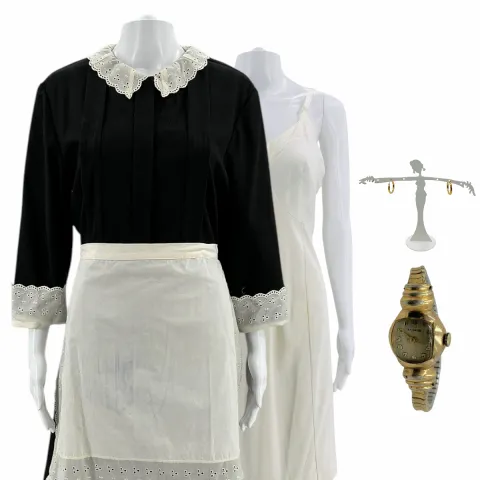 Lot 73 · VIP Fan Auctions The Help Constantine (Cicely Tyson) Screen Worn Dress, Slip, Stockings, Apron, Earrings & Watch Ch 3 Sc 173, 174a $550
-
 Lot 89524 · Heritage Auctions Alien Visitor Costume Ensemble from V (Warner Bros. TV, 1983). ... $5,250
-
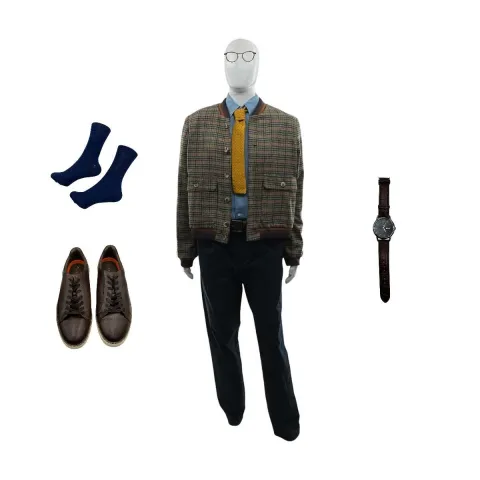 Lot 89 · VIP Fan Auctions The Sheep Detectives Elliot Mathews Screen Worn Stunt Double Trainers, Glasses, Watch, Belt, Socks, Tie, Button-Up Shirt, Jacket & Chinos Ch 1 Sc 114c $111
-
 Lot 12 · Icons of Pop Culture Better Call Saul (TV) - Mrs. Nguyen's (Eileen Fogarty) Wardrobe - 64-12 $28
-
 Lot 1124 · Propworx Stargate SG-1 Yat’Yir Jaffa Costume - Hero $261.98
-
 Lot 69 · VIP Fan Auctions Poker Face Season 2 Charlie Cale (Natasha Lyonne) Screen Worn Jacket & Pants Ch 3 Ep 203 $121
-
 Lot 195 · Propworx Stargate Dr. Beckett Trousers $86
-
 Lot 126 · Propworx Apollo’s Green BDUs $4,200