Julien's Auctions · Sale 381 · Lot 786
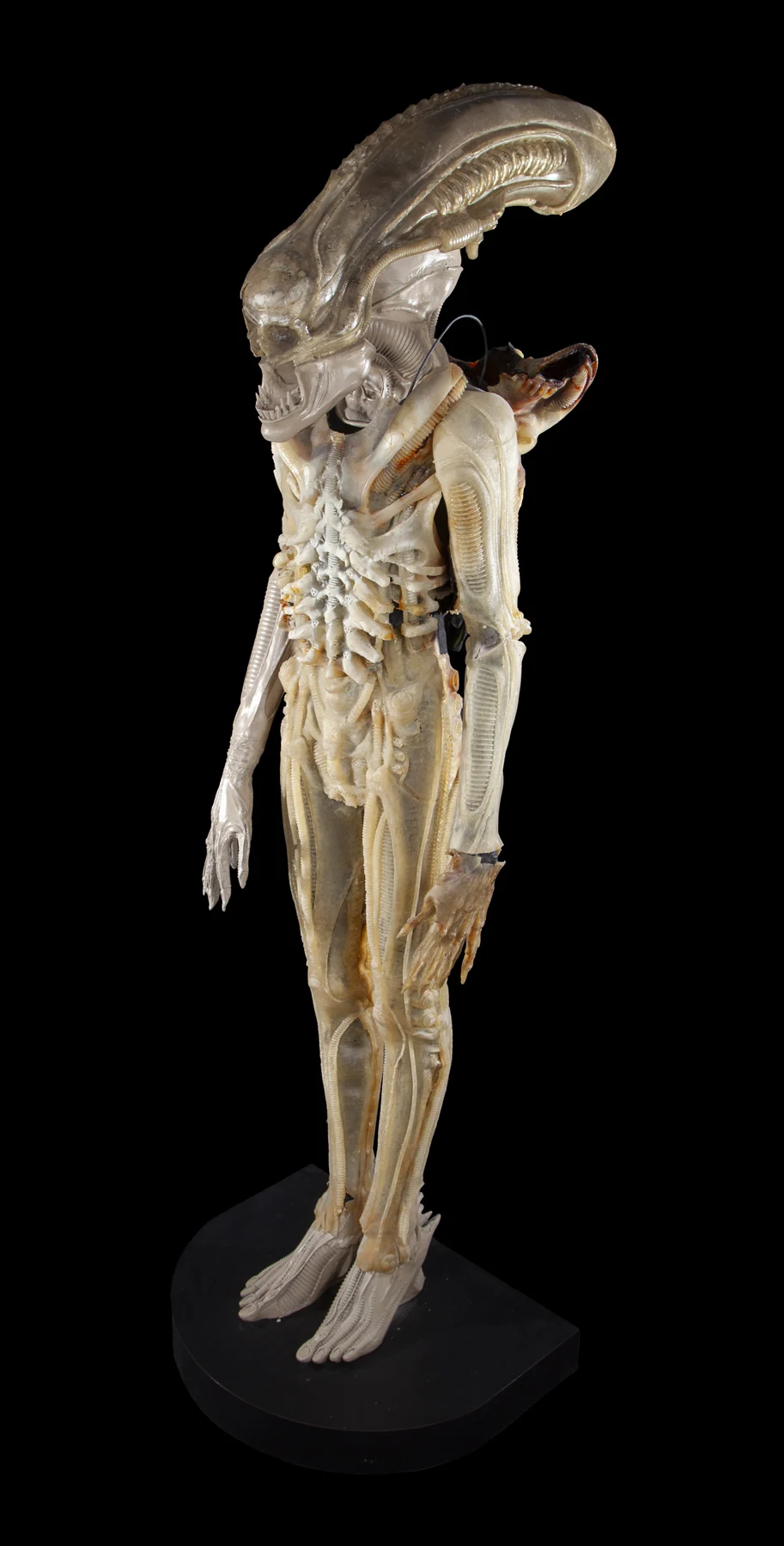
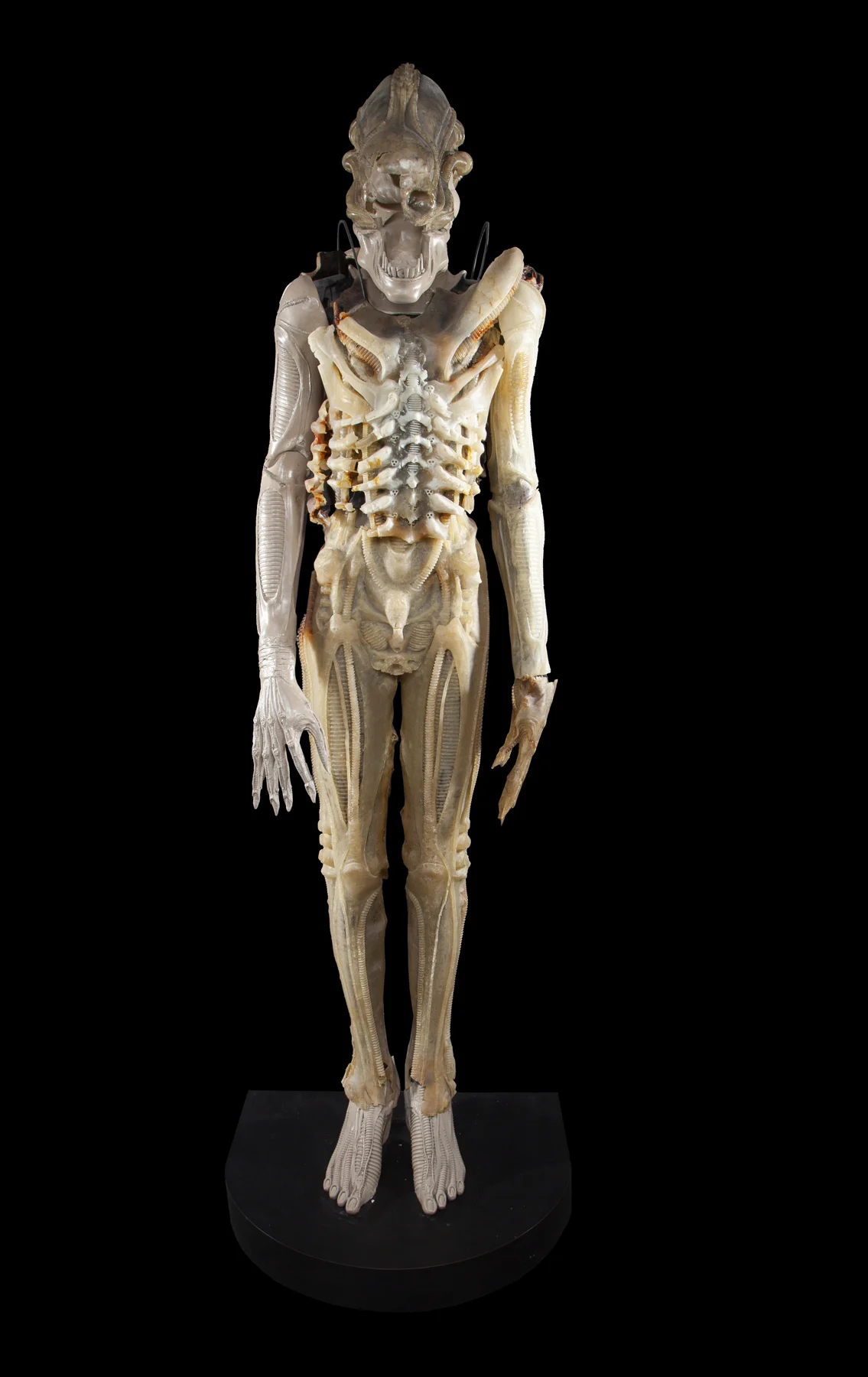
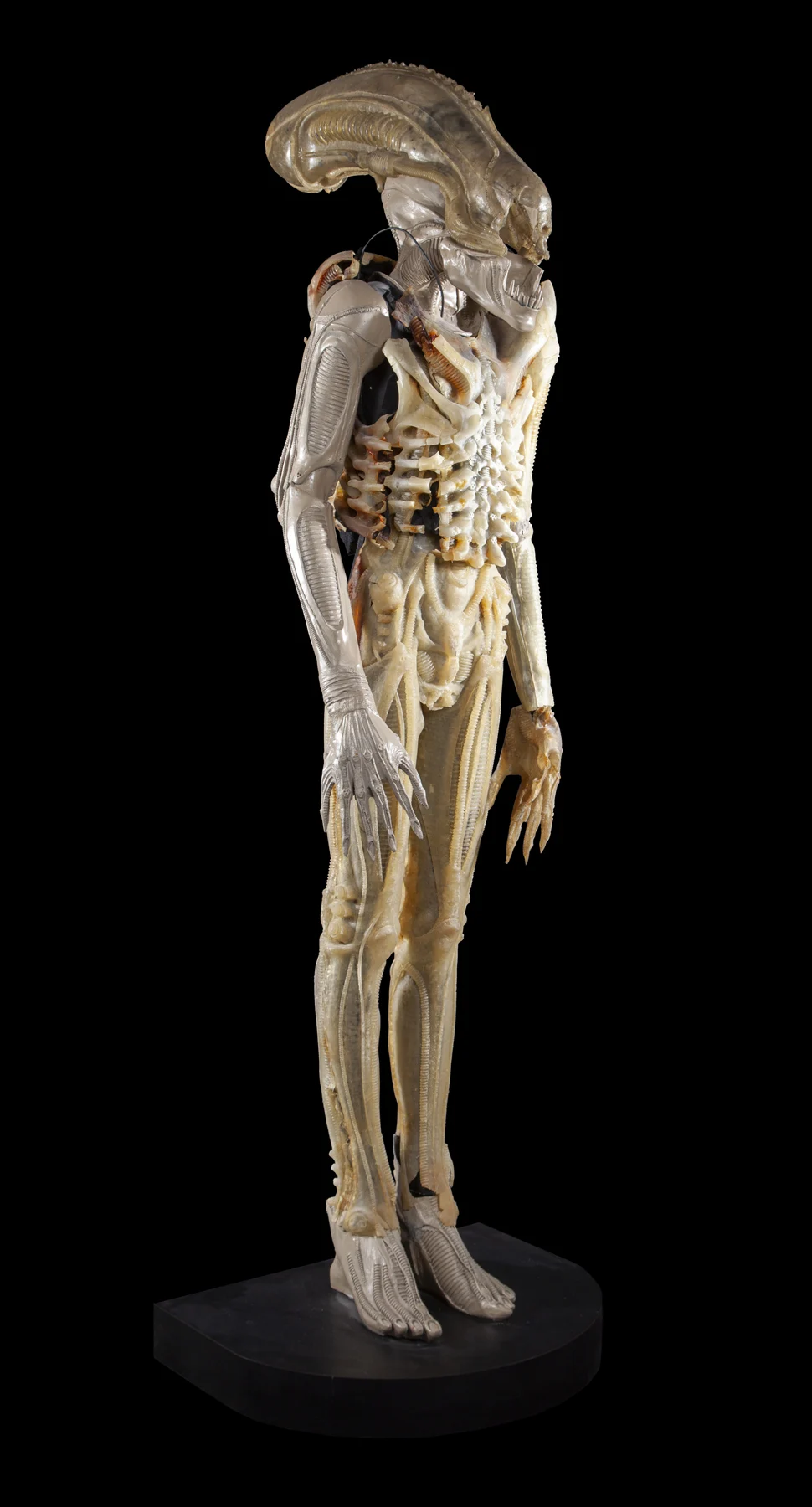
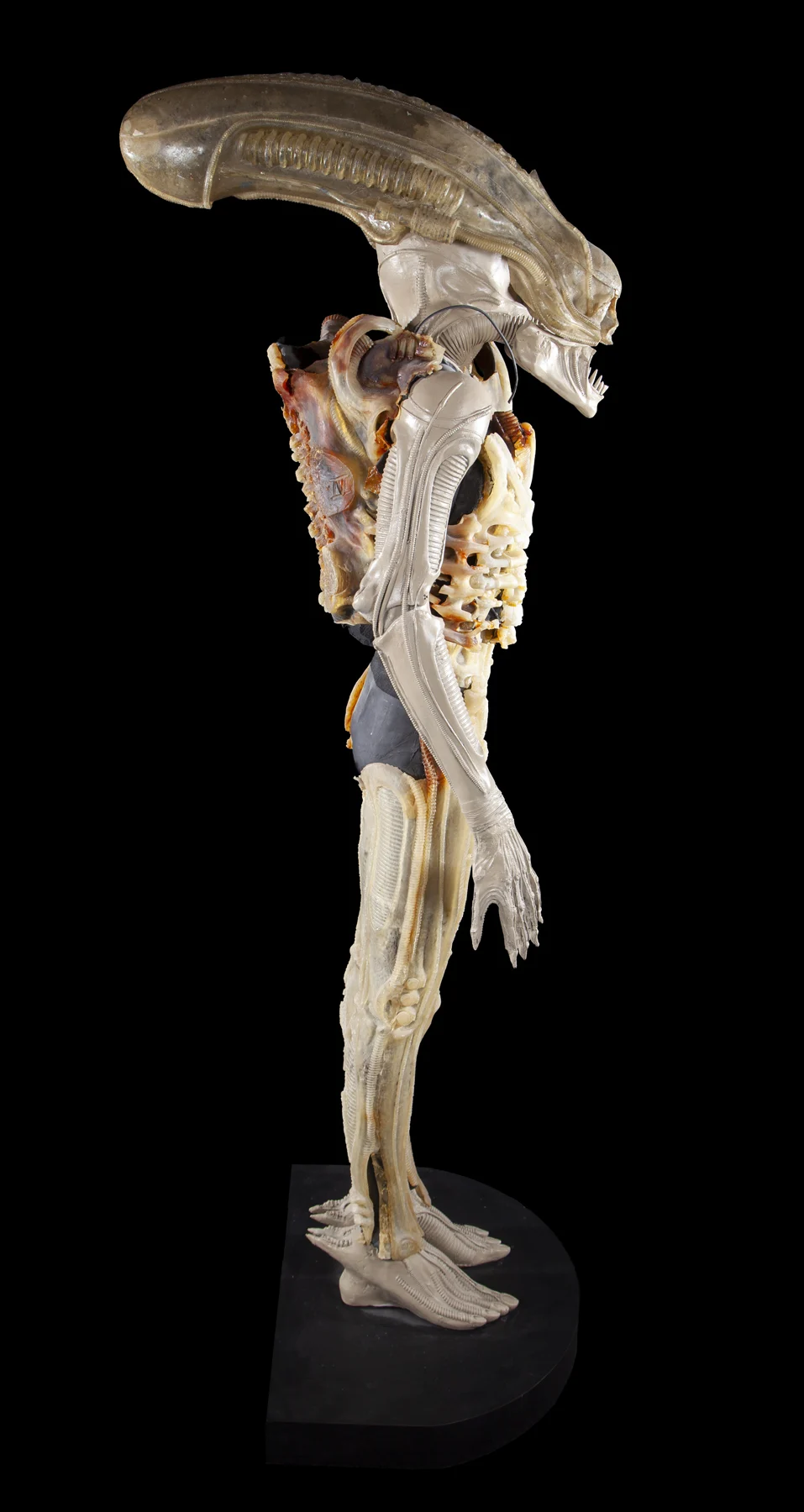
H.R. GIGER'S ORIGINAL PROTOTYPE TRANSLUCENT "BIG CHAP" XENOMORPH COSTUME DISPLAY FROM ALIEN
Photographs: © Julien's Auctions
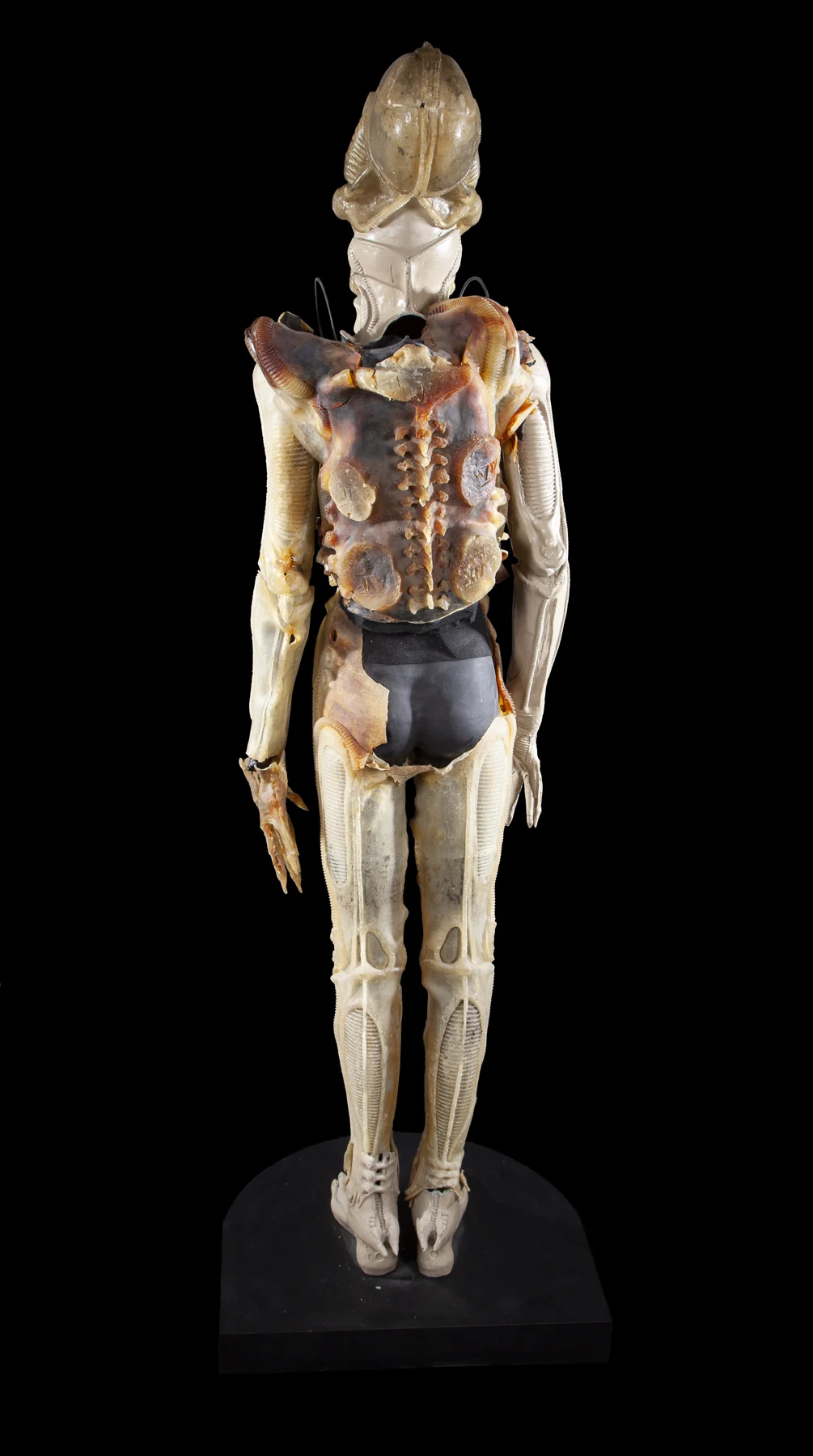
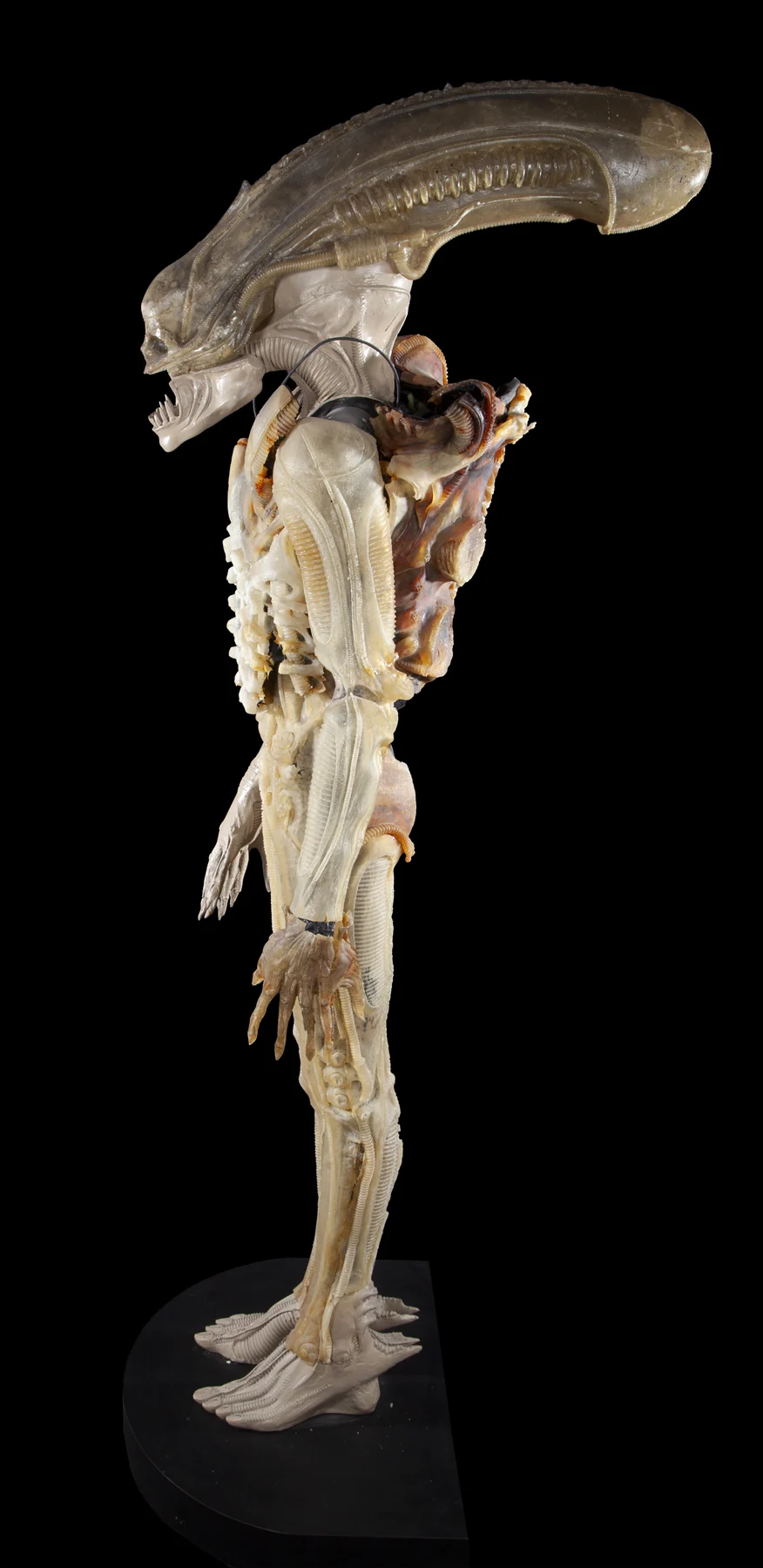
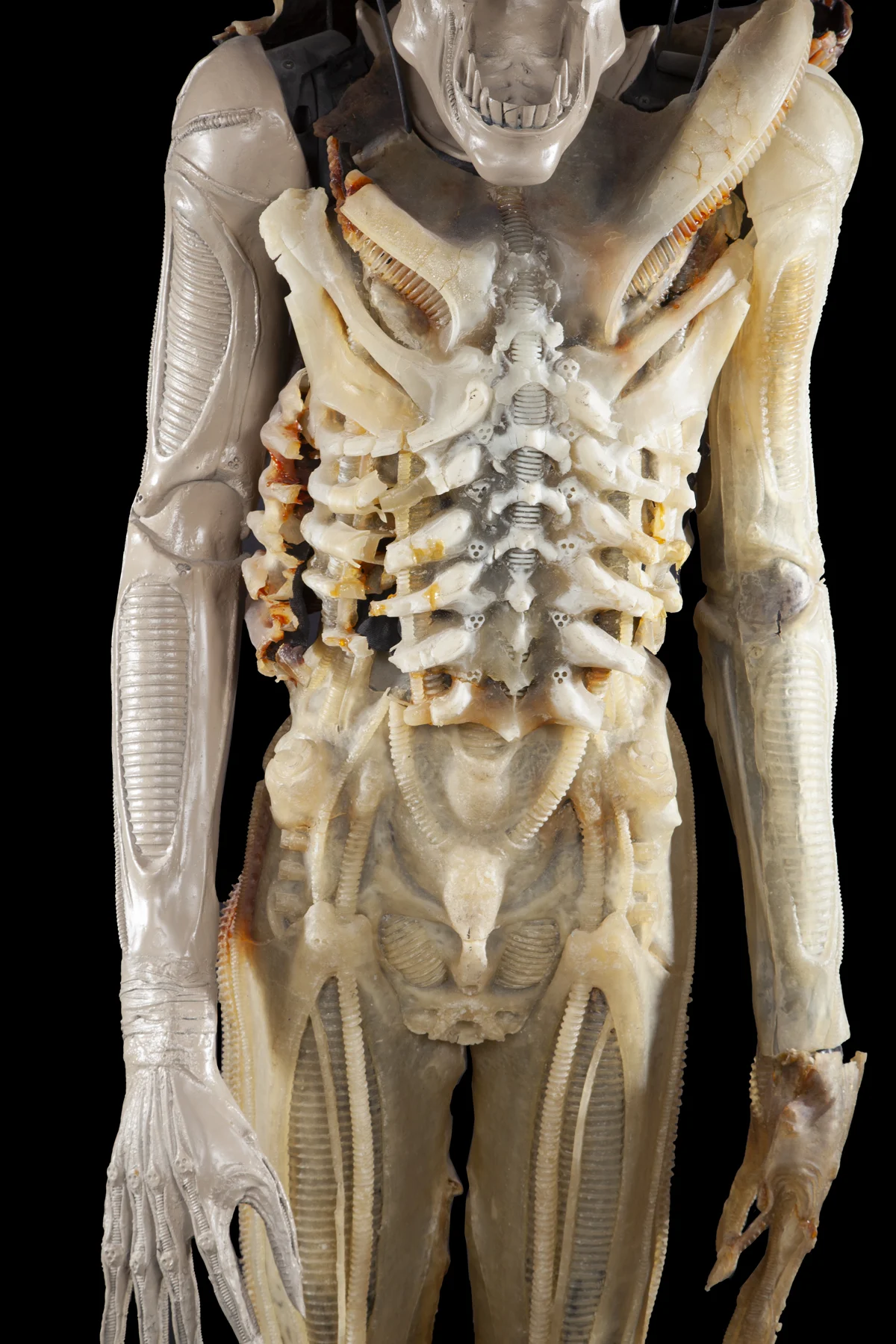
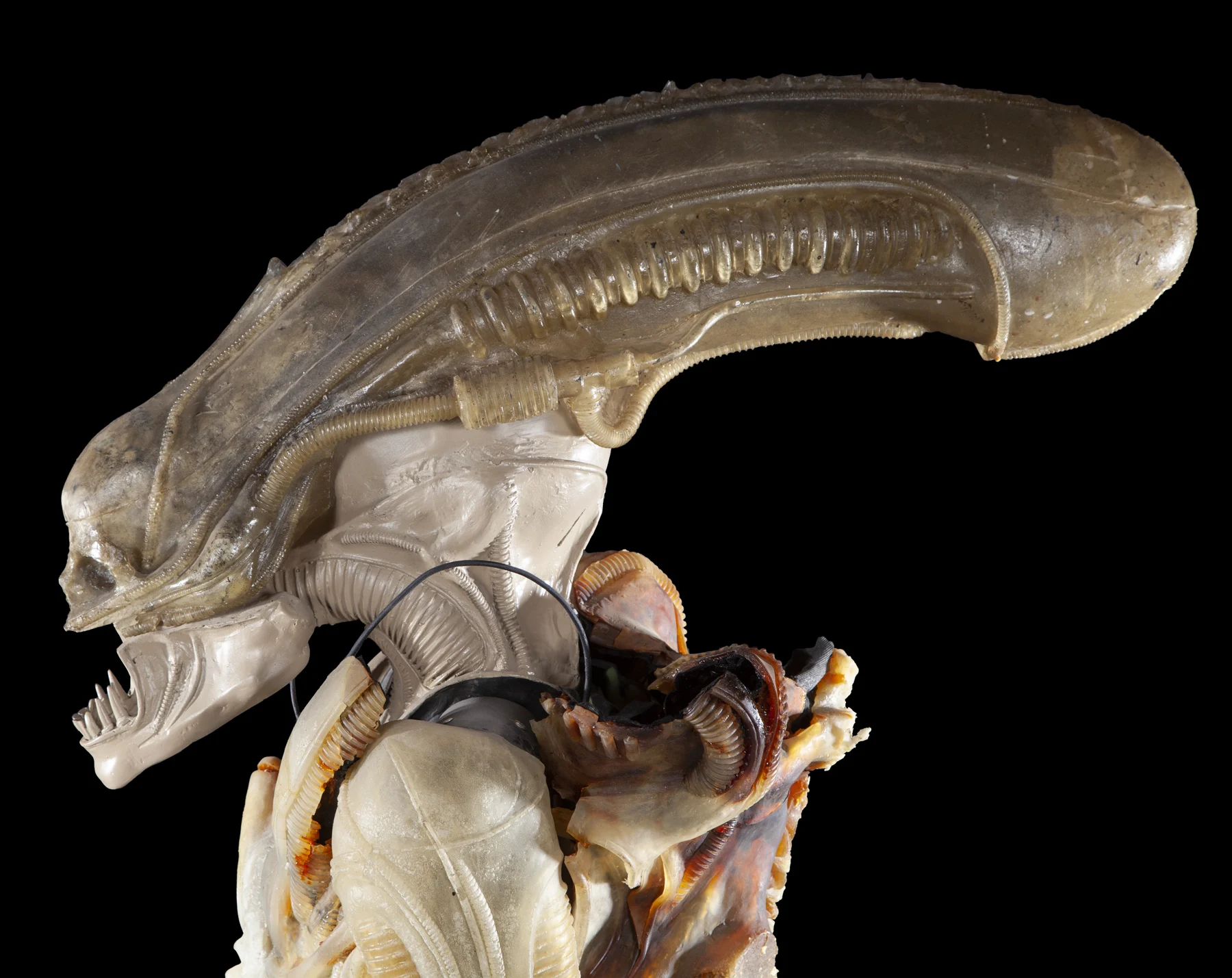
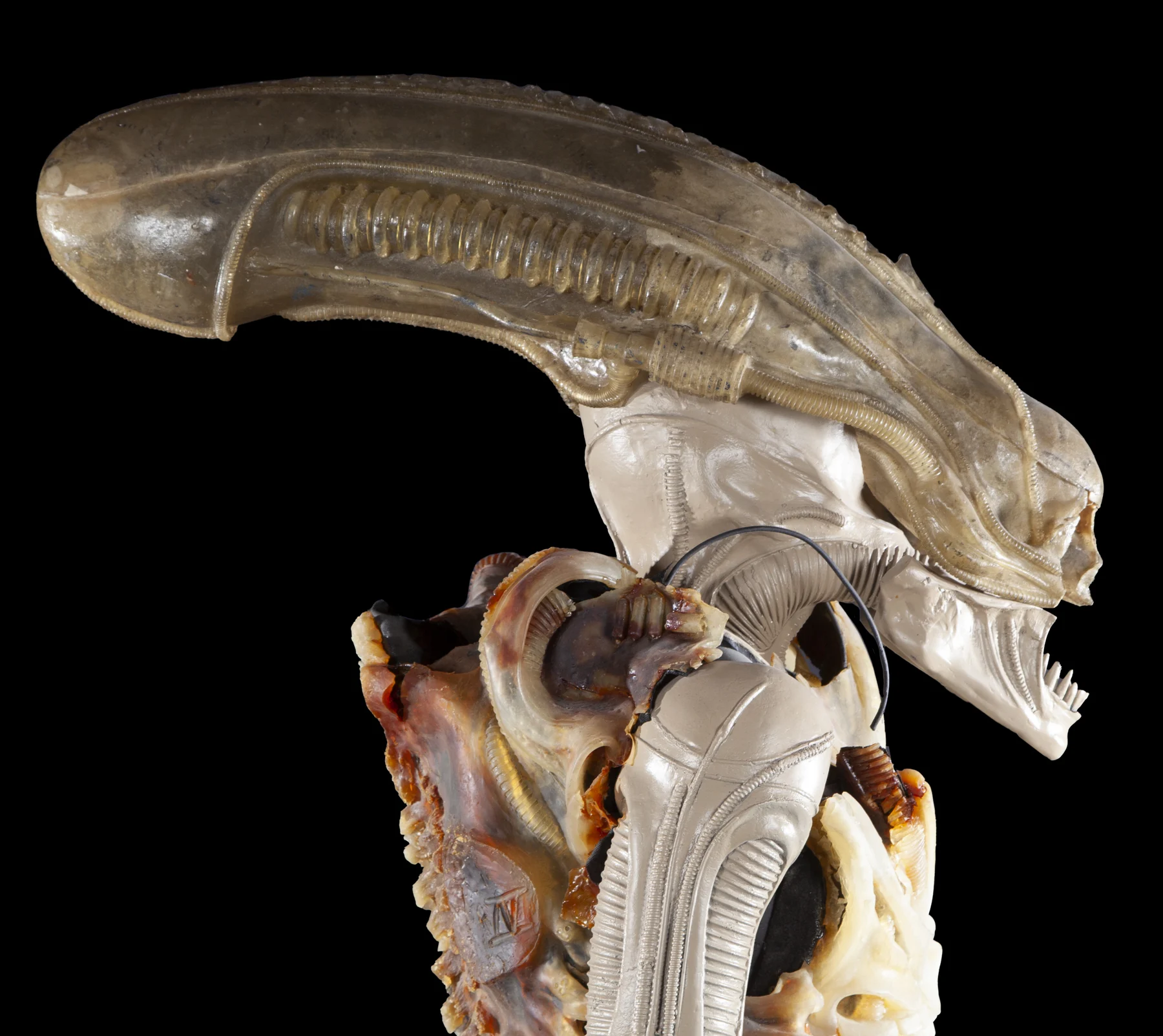
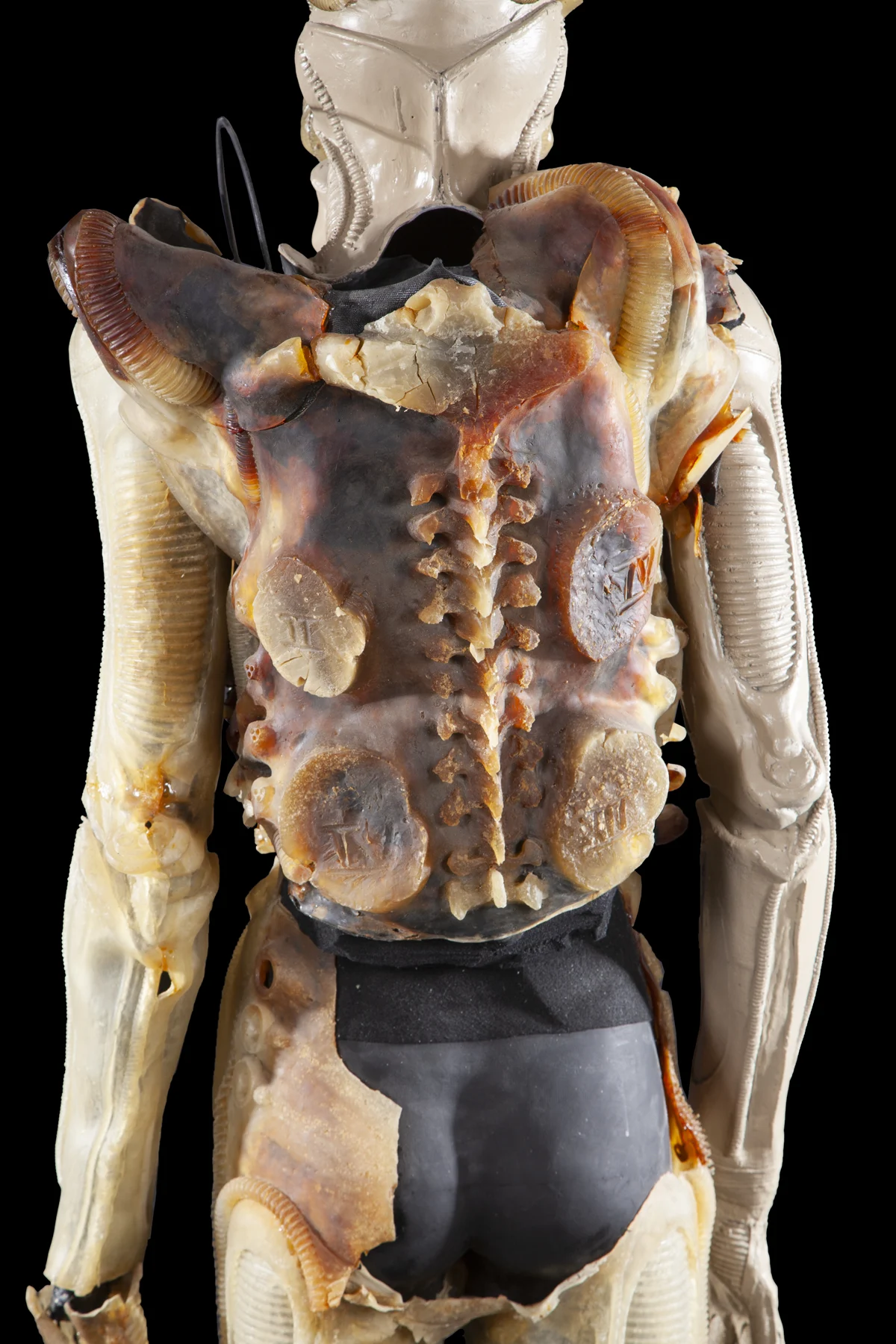
An early, extraordinary, original, authentic, full-size, translucent prototype Xenomorph costume (the full-size Alien costume being known as the “Big Chap”) designed by the surrealist artist and sculptor H.R. Giger for Ridley Scott’s Alien (20th Century Fox, 1979). The Xenomorphs are endoparasitoid extraterrestrial species that are the antagonists of the Alien film franchise.
“The Alien is elegant, fast and terrible. It exists to destroy - and destroys to exist. Once seen it will never be forgotten. It will remain with people who have seen it, perhaps in their dreams or nightmares, for a long, long time. Perhaps for all time.”
H.R. Giger, Mediascene, 1979
Long believed by cinema historians to have been lost and most likely destroyed, this extremely rare costume was a test prototype designed, developed and sculpted by the brilliant Academy Award-winning Giger (who won an Oscar for his work on Alien ), working in conjunction with the talented artisans at the renowned Shepperton Studios in the United Kingdom.
Created for consideration by celebrated film director Ridley Scott during the early stages of pre-production on the film Alien , when the Xenomorph creature suit was proposed to be largely translucent.
Conceptualizing And Creating A Hollywood Science Fiction & Horror Icon
When the “Alien” as the world would come to know it, was first introduced to movie going audiences over four decades ago in the classic science fiction horror motion picture Alien (the inaugural installment of the successful film franchise), completely unbeknownst to those audiences had been the monumental task in bringing the horrendous creation to the big screen. A challenge which had proven not only to be beyond difficult, but nearly an impossible feat for the filmmakers to overcome. What we now immediately recognize today as the legendary Hollywood science fiction & horror film icon, simply didn’t exist in cinema all those years ago.
At the time of Alien ’s release in 1979, CGI (Computerized Graphic Imagery) visual effects for movies were still years away from being able to adequately render a believable VFX creature on screen. Especially ones that would not only entertain audiences, but enthrall and intrigue them, while most importantly maintaining a consistent level of believability throughout the film. The need for a ‘suspension of disbelief during the watching of Alien was even more important considering that not having and maintaining it would risk undermining the landmark science fiction horror film’s wire taunt and ever growing level of pulse pounding suspense, crafted under the masterful direction of auteur filmmaker, Ridley Scott.
It had been around five years since audiences around the globe had been introduced to the memorable mechanical shark from the blockbuster Jaws (Universal, 1974), also a challenging movie that gave director Steven Spielberg PTSD (Post Traumatic Stress Disorder), and two years since the smash hit Star Wars (20th Century Fox, 1977) (which put director George Lucas in the hospital from complete nervous exhaustion) had been released. The latter film immersed audiences in “a galaxy, far, far away” , filled with unique and fascinating extraterrestrial life forms, which predominantly relied on traditional Hollywood make-up effects and foam latex creature costumes. However, it was wonderfully conceived, designed and executed. So theater goers were in effect tee’d up for yet another landmark cinematic experience upon Alien ’s release. But the bar had been significantly raised.
The fascinating, daunting, and intense journey of the conceptual design phase in bringing Ridley Scott and H.R. Giger’s vision for the Alien creature from its two dimensions seen in Giger’s awe-inspiring paintings to the three-dimensional entity required to film for the silver screen. The seemingly insurmountable challenges faced by Alien ’s make-up effects crew was on par with the most challenging movies ever produced in the history of cinema.
Enter H.R. Giger
Screenwriter Dan O’Bannon had envisioned a monster movie set in outer space that would be unique. Ultimately, the developing project that would become Alien was put on hold, as O”Bannon departed the U.S. for Europe to join the pre-production team on director Alejandro Jodorowsky”s planned, monumental production of Dune (Universal Pictures, 1984), a group which included UK artist Chris Foss, French comic book legend Jean “Moebius” Giraud, and the noted Swiss surrealist artist H.R. Giger.
“The whole thing really started in Salvadore Dali”s house,” Giger explained in an interview with Starlog magazine in 1979. “I have a friend in Spain, American painter Bob Venosa, who lived in Cadaqués, who is often in Dali”s house, and he brought some of my work to him” Jodorowsky came to Spain to ask Dali to play the Emperor in his film of Dune. So Dali showed him my work and Jodorowsky was impressed enough and thought I could do something for his film.” Giger then travelled to Dali”s home to meet the director, but missed him. “But I was able to meet Salvadore Dali,” Giger said. “He was very nice.” Giger eventually met with Jodorowsky in Paris, where the artist was formally asked to join Dune ”s conceptual design team, and was tasked with creating the desolate world and villainous planet Harkonnen.
“Jodorowsky had found these very good and fantastically original science fiction artists to design all of the costumes and sets and spacecraft for the production” O’Bannon reminisced about the conceptual design phase of the ill-fated Dune . “It was an amazing achievement. It was like being in an art museum.” But it was the astonishing work of Giger that stood out however and left the most indelible impression upon O’Bannon. “Giger’s visionary paintings and sculptures stunned me with their originality”, he recalled. “They started an idea turning over in my head - This guy should design a monster movie. Nobody had ever seen anything like this on the screen.”
When the ultimately doomed production of Dune fell apart O’Bannon ended up flying back to the U.S., sleeping on the couch of his close friend, fellow writer and eventual executive producer Ron Shusett. O’Bannon recalled: “There I was on his sofa,” O”Bannon told Fantastic Films magazine, “and I didn”t have any prospects at all. It was a terrible situation. I couldn”t stay on his sofa indefinitely so I hauled myself up out of my black depression and was going to do something “ I”m said to myself I’m going to write a script.”
With the imagery of Giger”s paintings still in his mind, O”Bannon “ended up writing a script about a Giger monster. When I got back to America I was still haunted by his work. His work was on my mind and when we sat down to write Alien I ended up visualising the thing as I was writing it. I found myself visualizing the Alien as a Giger painting.”
During the pre-production phase of the film, prior to 20th Century Fox locking down a director, when it came to designing Alien, O”Bannon utilized Jodorowsky”s artist gathering technique as a form of template: “Fox put me on a salary to go in and design the whole movie. So I hired concept artist Ron Cobb and I asked for Chris Foss who was in England and they actually hired him and flew him over.” Recruiting Giger was, firstly, rather simple. “In August of 1977, I got a call from O”Bannon,” Giger told Starlog magazine. “He asked if I would like to do some work for a film called Alien. I said, “yes, why not.’”
The adult Alien was described to Giger by O’Bannon in a pre-production letter, as being “very mobile, strong, and capable of tearing a man to pieces. It feeds on human flesh. This creature should be a profane abomination. loathsome. In any event, we wish you to feel free to create your own design.” Giger began to render and refine his first concepts for the creature in August/September, 1977.
Obtaining Giger to agree to design the Alien had been achieved, but securing approval from the film”s producers and the production company to hire him was an obstacle. “The first guy I started pushing at them to do the monster was Giger,” said O”Bannon. “I had a heck of a time trying to get the producers to hire Giger. They really didn”t want to get involved because he”s not a movie professional, he was some “whing-ding” in Zurich.”
The visionary, successful and highly respected commercial director Ridley Scott was hired by 20th Century Fox to helm Alien . Scott wanted to avoid the cliche of “ a man in the rubber suit” , which had been the traditional means of an alien lifeform being seen in the productions of science fiction and horror movies dating back to the 1950’s.
Ridley explained to Cinefantastique in 2008, “In those days, it boiled down to a guy in a rubber suit. The thing that I had always worried about was that the monster wouldn”t be good, because they rarely are. Probably the last great monster at the time was the little girl in the bed in The Exorcist. But all you had to put on her was the voice of Mercedes McCambridge “ that one trick was chilling.”
Scott was ultimately responsible for the hiring of Giger. “Ridley saw Giger”s stuff and he was snowed,” said Alien screenwriter Dan O”Bannon. Scott threatened the producers to walk away from the project if Giger wasn”t brought on board to oversee the creature designs, so they complied, though it would be a decision that they did later praise, with producer David Giler admitting to Cinefantastique magazine, “it”s a richly textured film, thanks to H.R. Giger”s work.”
“I was first introduced to H.R. Giger”s artwork during the very early stages of pre-production for Alien,” Scott recalled “Dan O”Bannon showed me a copy of Giger”s Necronomicon book, and I immediately saw the potential his work had to offer the project. The producers were a bit hesitant in initially committing to his art until they had a director locked up. In this case that wound up being me. My enthusiasm with regard to the film increased significantly as I realized we had the ability to create a monster that would be superior to most of those from the past. Initially, Giger wanted to design the creature from scratch. However, I was so impressed with his Necronom IV and V paintings from the Necronomicon book that I insisted he follow their form. I had never been so sure of anything in my life. They were quite specific to what I envisioned for the film, particularly in the unique manner in which they conveyed both horror and beauty.”
“I”d seen conceptual drawings that other artists had tried rendering of the Alien,” Scott said to Fantastic Films magazine in 1979. “They always seemed to be of scaly bodies with claws, or huge blobs that would move across the floor. There was no elegance to them, no lethalness. What emerged was a H.R. Giger-designed humanoid with distinctively biomechanoid tendencies. I mean, really, how many creatures in horror films have actually worked for you? People only accept them because that”s what they”re seeing. When we finally had something acceptable we stood back and looked at him. For better or worse, we were committed to that thing as the beast. He was great on paper, and when Giger put the model together, he looked terrific.”
“When we started,” Giger said in an interview with Famous Monsters magazine, “Ridley said, “I haven”t seen any good monsters lately in films.” I mean, to do a horror or monster movie nowadays we didn't have many good examples. We decided to choose something from my Necronomicon book.”
Mia Bonzanigo, described as Giger”s “secretary / girlfriend / muse / model” by Cinefantastique magazine, described Giger”s state of mind during the pre-production and production phase: “He used to have nightmares and would even talk in his sleep because of the terrible pressure imposed on him by the production.”
“Sometimes,” Giger said to Famous Monsters magazine, “I couldn”t sleep because I was afraid I wouldn”t be ready with the design by the deadline. I mean, the Alien had to be the star of the film, and if the star is no good the film is lost.” Giger told Cinephage magazine in 1992: “I still see the H stage, the studios at Shepperton, filled with smoke and oil burning. Outside, the sun was shining and we entered the studio and were suddenly in the mist. It was crazy! I had to be there every day. It was completely stressful” I wanted things to be done well.”
The Birth Of The Alien
In its final screen form, as designed by the dark, mysterious and enigmatic Swiss surrealist artist H.R. Giger, it seemed as if the Alien had been birthed out of a strange biological merger of well-oiled machinery and both exterrestrial & human anatomy. As an accomplished illustrator, painter and sculptor painter, Giger had pioneered a unique style which was immediately recognizable, which he came to refer to as “biomechanical.”
It was no secret that Giger was fascinated with the occult, or at least the occult related imagery that appeared in much of his artwork. And the Alien appeared as if it had been actually designed, engineered and brought into being by some seriously demonic, otherworldly entity. That perception only furthered inspired the artist’s work. Giger enjoyed unsettling the viewer of his artwork. Pulling them into his nightmarish world. Frightening someone was stimulating them. Getting a rise out of them.
Upon the release of the film, the response to the first full reveal in the cinema of the Alien in all of its otherworldly glory was unforgettable. Triggering primordial fears in audiences worldwide, including revulsion to insects (the giant tick like in color swollen head of the creature), being bitten, clawed or eaten, experiencing the ghastly air of impending death while being drooled over by a ravenous predator, and facing down an overpowering opponent exuding enough unsettling, sexual sense overload metaphor (as is shown throughout the film) to bowl over even an experienced psychotherapist. Interestingly, one of Giger’s first art portfolios was entitled “A Feast For The Psychiatrist.”
Once movie goers were allowed more than just a peak at the Alien, its towering scale was intimidating enough without the addition of its massive, looming and horrendous, phallic like head. Which was so completely over the top, yet so intriguing, that it demanded further scrutiny, regardless of an audience member’s fright level. Which was only made all the more threatening by being accentuated by a pair of unnerving, double-set jaws (an outer and an extendable inner), brandishing sharp, menacing biomechanical metal teeth. The Alien put film goers into a state of mind, that led to having horrendous nightmares we didn’t even know we were capable of having.
It didn’t matter what we thought was biologically possible in design while watching Alien for the first time nearly 40 years ago. Here what we were witnessing on screen was what appeared to be a completely unknown and actual extraterrestrial threatening lifeform, the likes of which no one on Earth had ever seen. The truth is we willingly gave ourselves to the star beast (as O’Bannon first dubbed it) the way people visit dark rides at amusement parks in order to be frightened. But this was a level of transcendent fear taken to a new, unprecedented level.
The Alien was a species that could seemingly blend into mechanical surroundings for camouflage, or disappear suddenly into the darkness of an air duct as if it was an occupant of an interstellar haunted house. We may not have been on that ill-fated spacecraft the Nostromo, but we might as well have been. It was not the suspension of our disbelief, it was the eradication of it.
Movie-going audiences in the late 1970’s expecting to see a less threatening Star Wars -style alien, were left saucer-eyed, speechless and with the hairs on their neck and arms standing at full attention. Here was something so unseen at the time on film, that it was difficult to fully process. To wrap one’s mind around it. “What am I seeing?” “What is that?” Seeing Alien the year it was released was truly a close encounter of the frightful kind.
Film goers were riveted into their seats as Alien , under the brilliant direction of auteur Ridley Scott, consistently ratcheted up the tension, act after act after act, to an almost unimaginable level at that time in movie theater going experiences. Complete with an exhausting and yet ultimately fulfilling, double crescendo ending. Which made watching Alien a cinematic event in the late 1970’s that wasn’t ever forgotten.
The Translucent Alien
One of the most interesting and largely unknown by moviegoers conceptual design experiments conducted by the pre-production team on Alien was the attempts to make the Alien Biomechaniod creature suit nearly completely translucent.
“Ridley wanted the Alien”s body to be translucent,” Giger stated in an interview with Total Movie magazine in 2001, “So you could see the black actor, Bolaji Badejo (who portrayed the Alien when not being performed by a stunt actor Eddie Powell) , moving like a spider-thing inside of this half transparent suit.”
In his production diary kept during the production of Alien , Giger noted that: “One should be able to see the skeleton, the blood circulatory system, the organs etc.” “In the way I”ve made my biomechanoids.”
“Ridley said it might be good to use their physical look covered with sort of ‘translucent clothes’ so you could see the skin. But then we had trouble transferring that concept into reality.” Giger told Famous Monsters magazine in an interview. A prototype suit was in fact fabricated, but the material used was not durable enough and would tear much more easily than the rubber they ended up utilizing.
“They built special ovens for this plastic material,” said Giger, “like hot-melt vinyl, but it was not transparent enough to see through to the person behind it and it didn”t work.” Giger wrote that had he been given ample time, the transparent suit might have been feasible. “The molding and casting shop keeps producing more and more transparent costumes,” Giger wrote. “However the ideal solution has still not been found, because the material is not resistant enough and tears” Unfortunately they still haven’t produced anything we can use, and time is running short.”
With production pressures mounting, the process of attempting to fabricate the translucent Alien costume was turning out to be more and more complex and the results unsatisfactory. After close to two weeks of experimenting, Giger wrote again that, “They have still not come up with any satisfactory result. The molds have been badly damaged by his experiments and the great heat, and have to be patched up by the plasterers in meticulous detail, or even made all over again.” Giger later told Famous Monsters magazine that “It turned out to be a... how you say... a night dream... uh, a nightmare.”
Comprehensive lighting and camera tests were conducted by the pre-production team on Alien to demonstrate the potential of the Translucent costume to director Ridley Scott and the producers of the film.
The production had also intended to line the inside of the clear carapace with maggots, so that when the Alien leered towards the camera the inside of its skull would appear to be crawling with life. Unfortunately, this experiment also failed when the maggots fell asleep under the hot studio lights and became inert.
“At one stage,” Ridley explained to Cinefex, “I wanted to have a kind of subtle movement in the creature”s brain, so I thought maybe we could fill a pocket in the cranium with white maggots and let them crawl around in there. Even Giger went “Eeyuk!” at that one. But I decided to try it, so I had these huge tins of maggots brought in. We couldn”t make it work, though, because the heat from the lights would put the bloody things to sleep and they”d just lie there like spaghetti. We tried using Spanish fish, which look kind of like wireworms, but they went to sleep too. So finally I had to give up.” Still endeavoring to experiment, Scott came up with another idea: “Afterwards, I thought we should have tried sprinkling LSD on sugar, because maggots love sugar. Then maybe we”d have gotten some reaction out of them.”
The final ‘non-translucent’ costume was what was ultimately seen on screen.
The Translucent Alien creature costume was packed away and stored and the rumors of its existence became a kind of urban myth among Alien enthusiasts and collectors. Only a few behind the scenes production photos revealed its fabrication. There was nearly no information regarding its whereabouts or condition in the decades following the original release of Alien . However in 2012, SPFX technician Dennis Lowe shared images of the original Translucent Alien costume which had been originally rescued by Alien’s associate film producer, Ivor Powell. Interestingly, the discoloration of its latex skin had aged akin to that of human-like skin. A portion of the Alien skull survived remarkably resembling the ridged head style Aliens seen in the James Cameron directed blockbuster sequel film Aliens (20th Century Fox, 1986).
Interestingly, the extraterrestrials in Alien ’s prequel film, Prometheus (20th Century Fox, 2012) are described as having translucent skin, so eventually Giger and Scott”s wishes were fulfilled on screen.
The Display Offered In This Exclusive Historic Auction
It is miraculous that this Alien costume survived and exists in any form, nearly half a century after it was created for the film, predominantly as a test costume. This creature suit was fabricated, positioned, fitted, lit, shot, experimented on, altered, repaired, man-handled and discarded after filming, when Alien producer Ivor Powell rescued the costume as it was being thrown away into a studio dumpster. Never intended to be filmed, the act of it being saved and preserved as it was is truly astonishing.
The remaining parts of the costume have been carefully built onto a full-size custom mannequin with almond-sprayed reproduction pieces cast off of original Alien creature costume components utilized to complete the display, as well as to assist in the preservation of all of the parts and pieces. This work was painstakingly provided by the highly respected Hollywood memorabilia restoration experts at Tom Spina Designs.
This extraordinary costume is now considered the rarest and most elusive artifact from the Alien film franchise.