Julien's Auctions · Sale 381 · Lot 765
PRODUCTION BLUEPRINT AND ASSORTED PRINTED MATTER FROM STAR TREK: FIRST CONTACT
Photographs: © Julien's Auctions
Various pieces of production material related to Star Trek television and film production.
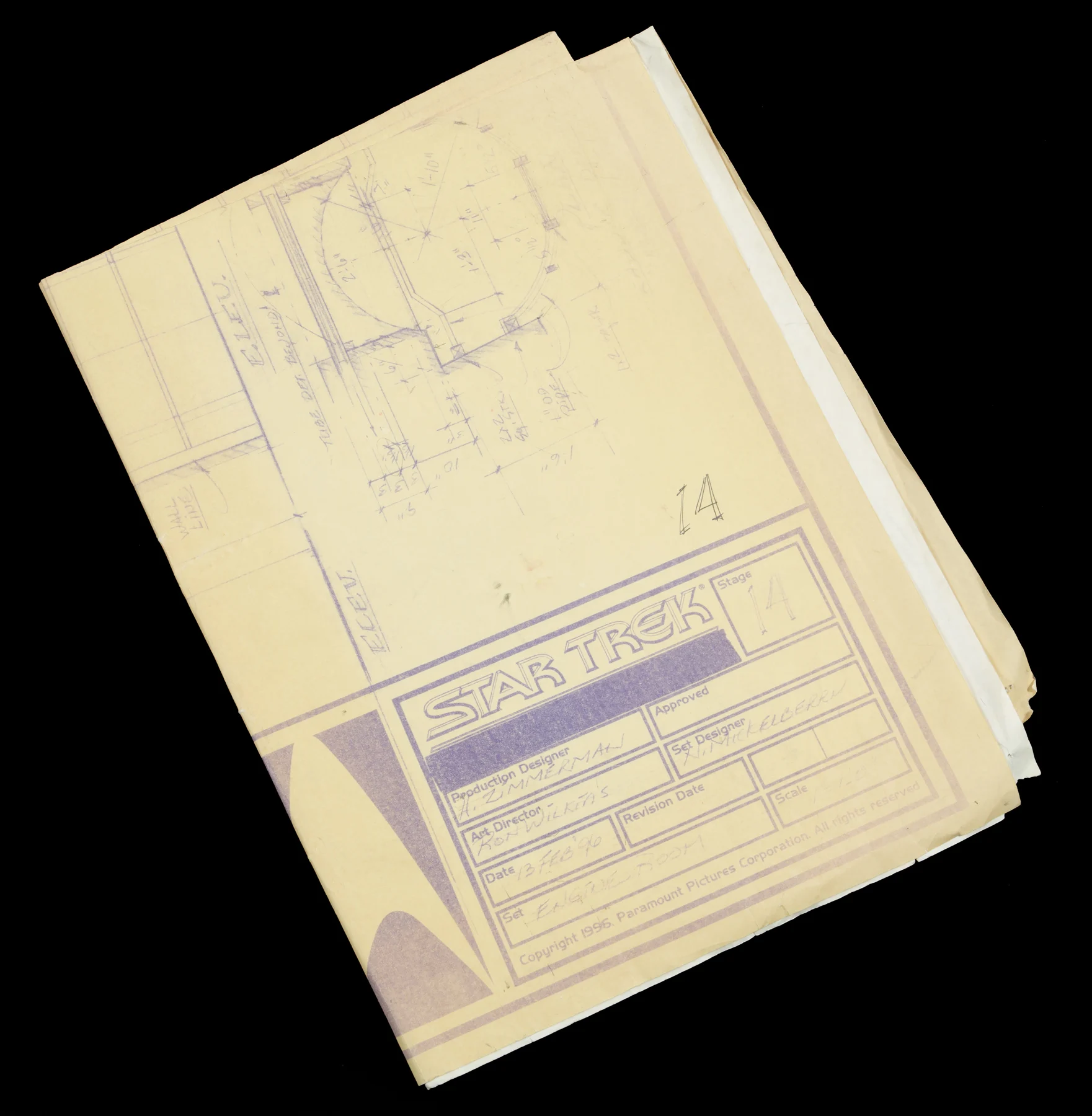
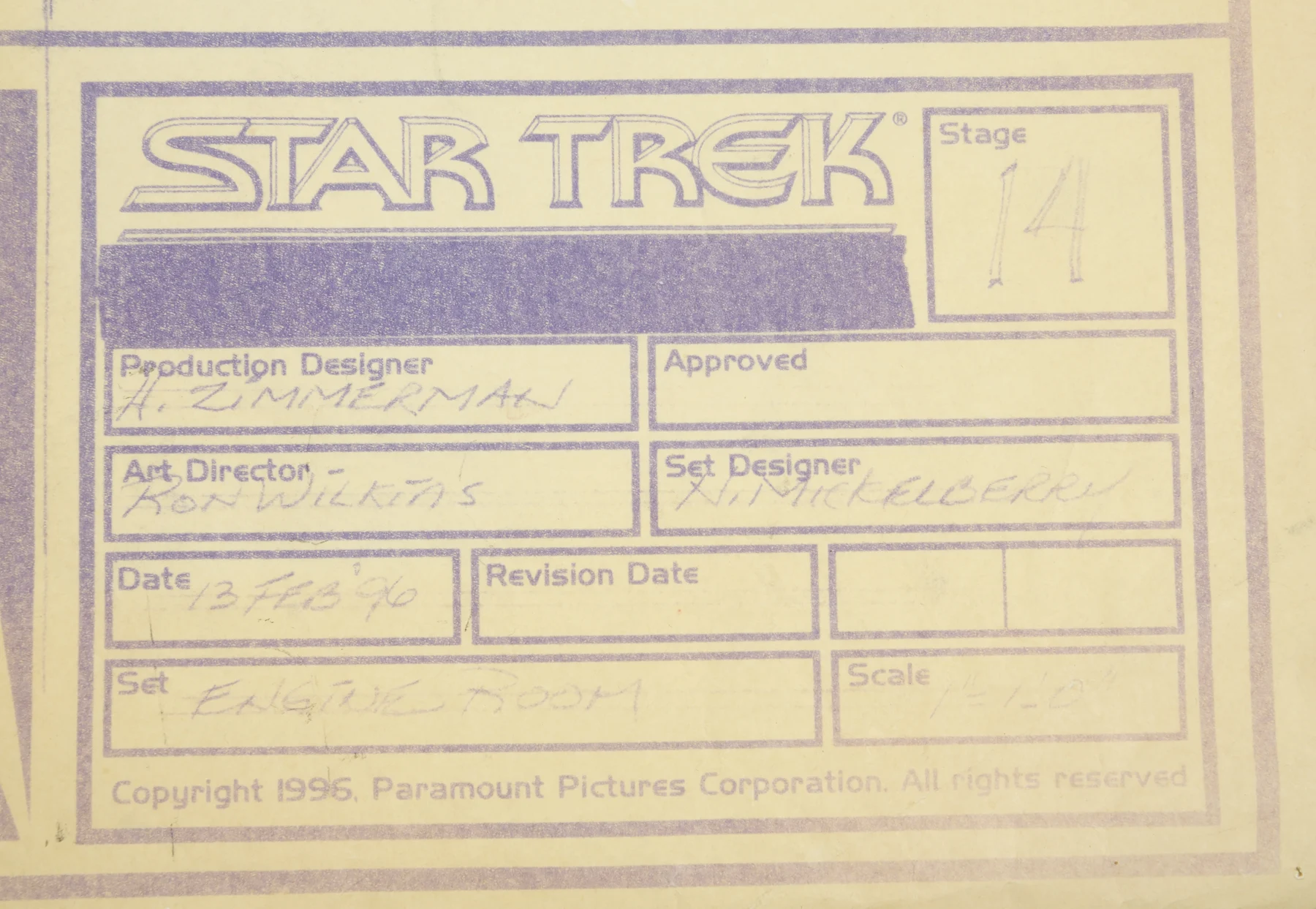
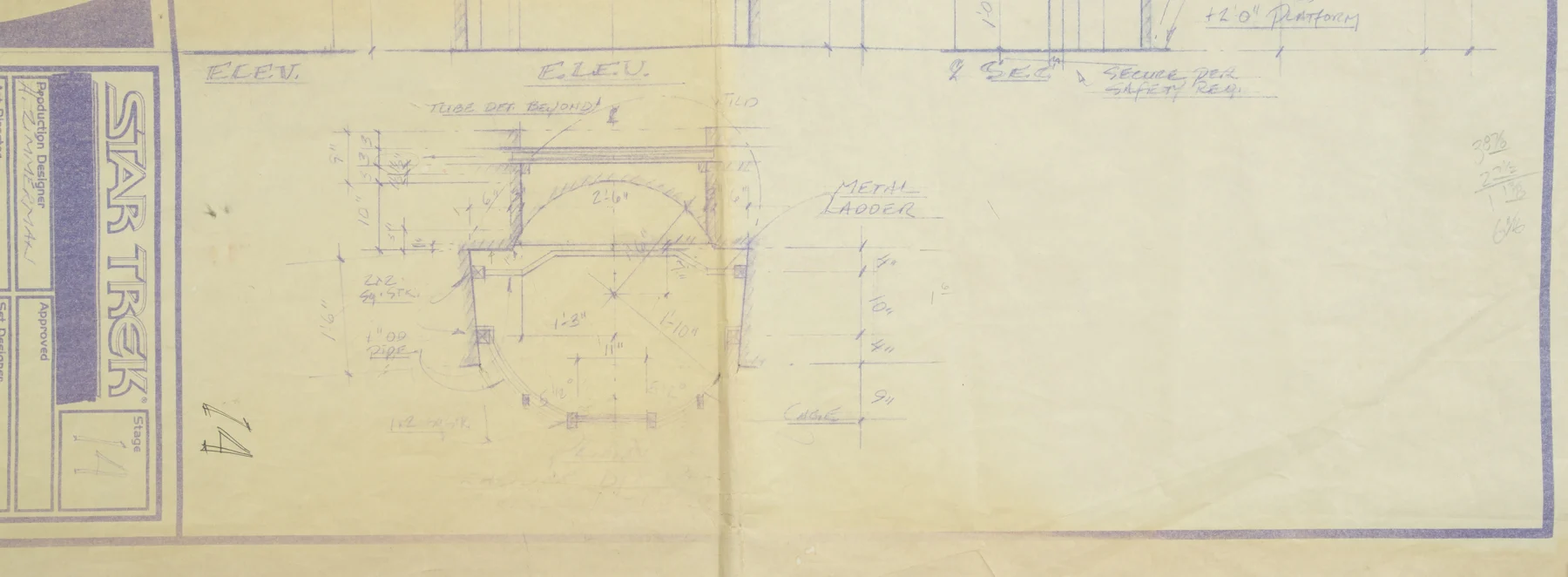
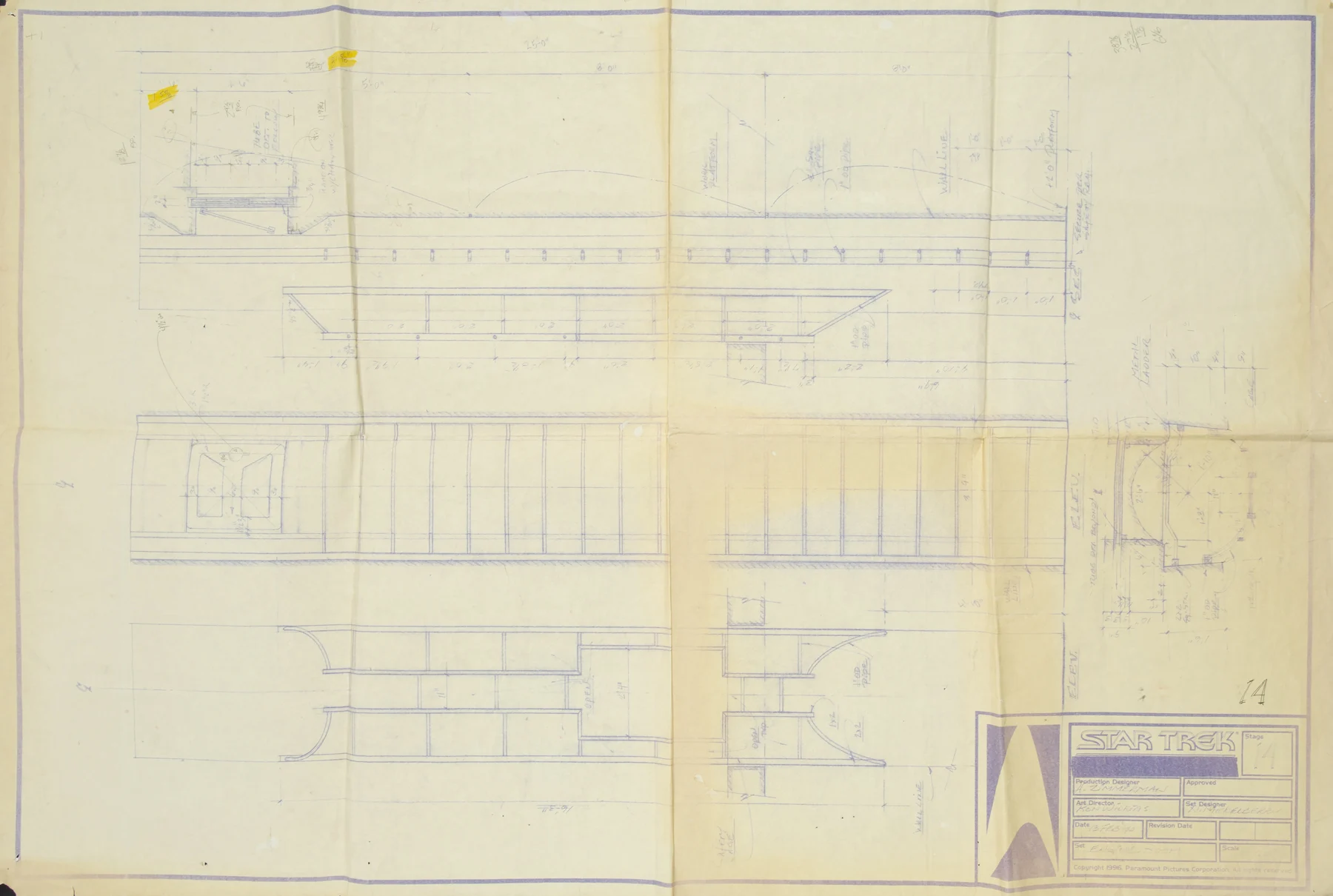
An original, hand-drawn blueprint of engine room components aboard the USS Enterprise-E, used for the production of Star Trek: First Contact (Paramount Pictures, 1996). This piece is dated Feb. 13, 1996, and lists Stage 14 as the soundstage used. That was where a brand-new Engineering set was constructed for the film, the first Star Trek production since 1990 to introduce a new Enterprise into franchise canon.
Since the crew of Star Trek: The Next Generation (Paramount Television, 1987-1994) would be flying a new ship (the Enterprise-D was destroyed during the previous film in the series), the production needed new sets. This engine room was designed by Herman Zimmerman (H. Zimmerman in the credit box), art director Ron Wilkins and set designer Nancy Mickelberry after final design of the ship was approved in January of 1996. The blueprint shows details of metal ladders and alcoves on the periphery of the set. (36 by 24 inches).
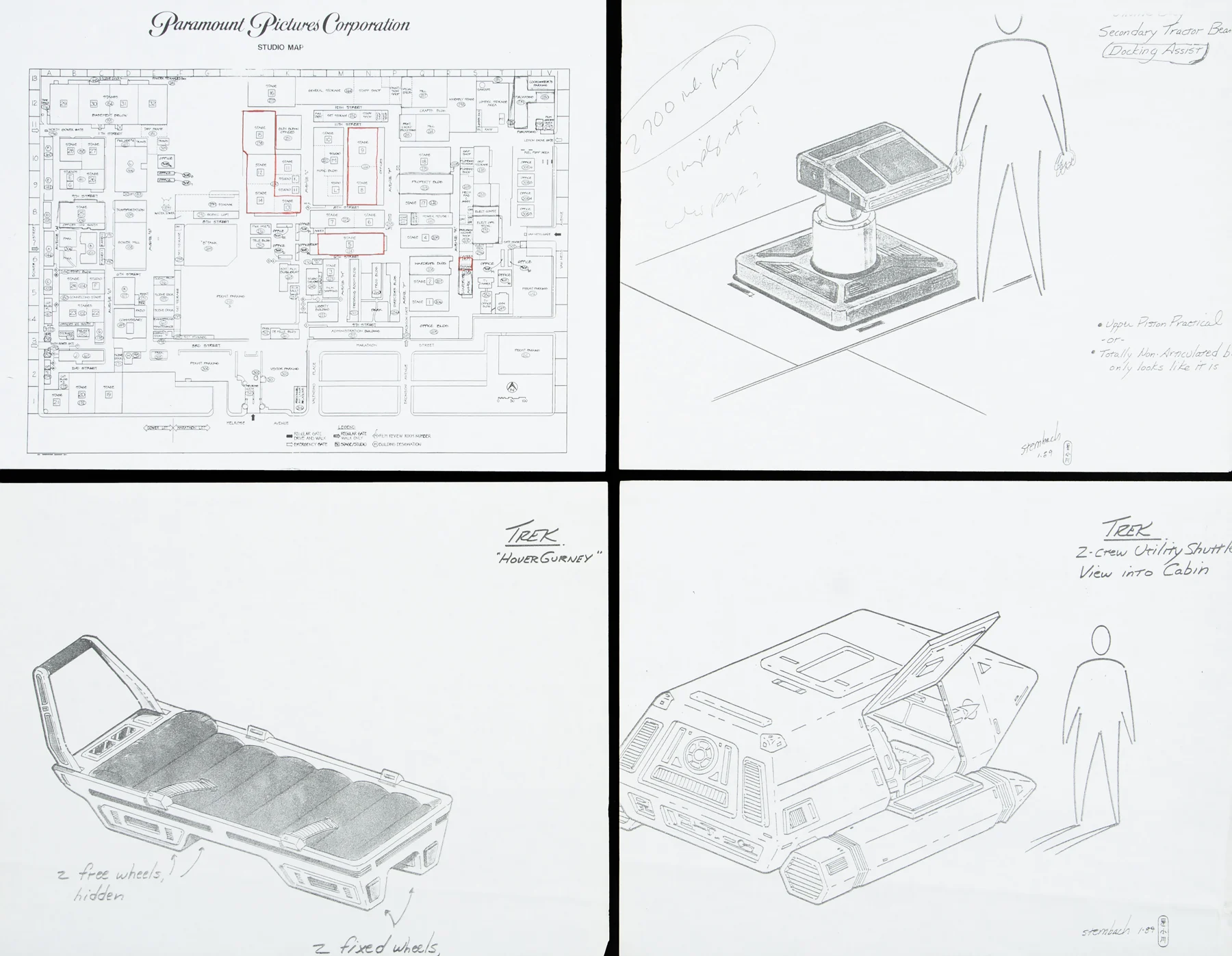
A xerographed production copy of a Rick Sternbach design sketch from January, 1989 for the design of the USS Enterprise-D’s secondary tractor beam from Shuttlebay 2, which assisted docking and landing maneuvers. Sternbach (b. 1951) was the senior production illustrator/designer for Star Trek : The Motion Picture (Paramount Pictures, 1979), Star Trek: The Next Generation , the first two seasons of Star Trek: Deep Space Nine (Paramount Television, 1993-1999) and Star Trek: Voyager (Paramount Television, 1995-2001). This design first appeared in The Next Generation season two episode, “Time Squared.” That episode’s script was completed on Jan. 25, 1989, and it was shot from Jan. 27 to Feb. 2, 1989. The sketch from Sternbach is dated 1.89, which appears under his signature. (8 by 11 inches)
A xerographed production copy of an original Rick Sternbach sketch of a utility shuttle design used in Star Trek: The Next Generation season two episode “Time Squared,” dated January, 1989. (8 by 11 inches)
An undated and unsigned production design of a hover gurney used in Star Trek: The Next Generation , with notes showing where two free (rotating) wheels and where the two fixed wheels would be affixed on the real-world prop. A simplified prop bearing the hallmarks of this design was used in the season two episode, “Time Squared.” (8 by 11 inches)
An undated xerographed map of the Paramount Pictures lot, with red pen markings highlighting Stages 5, 8, 9, 12, 13, 14 and 15, as well as the camera department a historic tour of filming locations used throughout Star Trek history.
The stages were used collectively for every live-action Star Trek television and film project, from episodes of the original series (Stage 5) through the 2009 reboot. Stage 9 is arguably the most historic stage highlighted, as it hosted filming for the first seven Star Trek feature films, episodes of Star Trek: The Next Generation, Star Trek: Voyager, and Star Trek: Enterprise (Paramount Television, 2001-2005), and the 2009 film starring Chris Pine, Zachary Quinto, Karl Urban and Zoe Saldana.
Stages 9, 12, 14 and 15 were used in the production of Star Trek III: The Search For Spock (Paramount Pictures, 1984). Stage 15 nearly burned down during filming when Planet Genesis exteriors caught fire. William Shatner - Captain Kirk himself - helped man the hoses that doused the flames while still in full costume. He was desperate that the film’s shooting finish on schedule, since he was slated to start filming the television series, T.J. Hooker (Spelling Goldberg Productions, 1982-1986), after the film wrapped. (8 by 11 inches)
Dimensions: 36 by 24 inches (largest)