Julien's Auctions · Sale 353 · Lot 897
2001: A SPACE ODYSSEY SPACESUIT WITH ICONIC MULTI-SCENE/COLOR HELMET AND MGM SHIPPING CRATE
Photographs: © Julien's Auctions
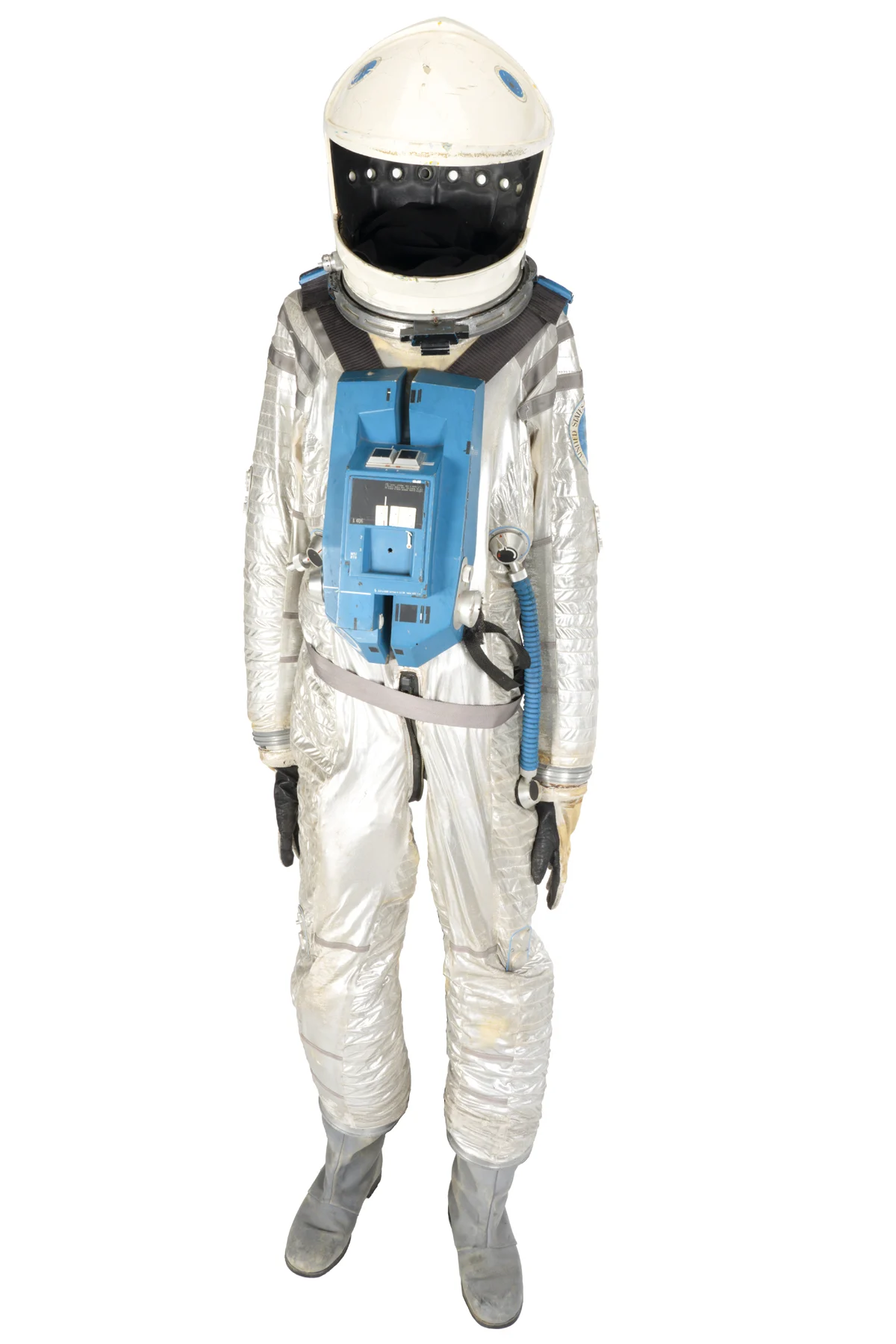
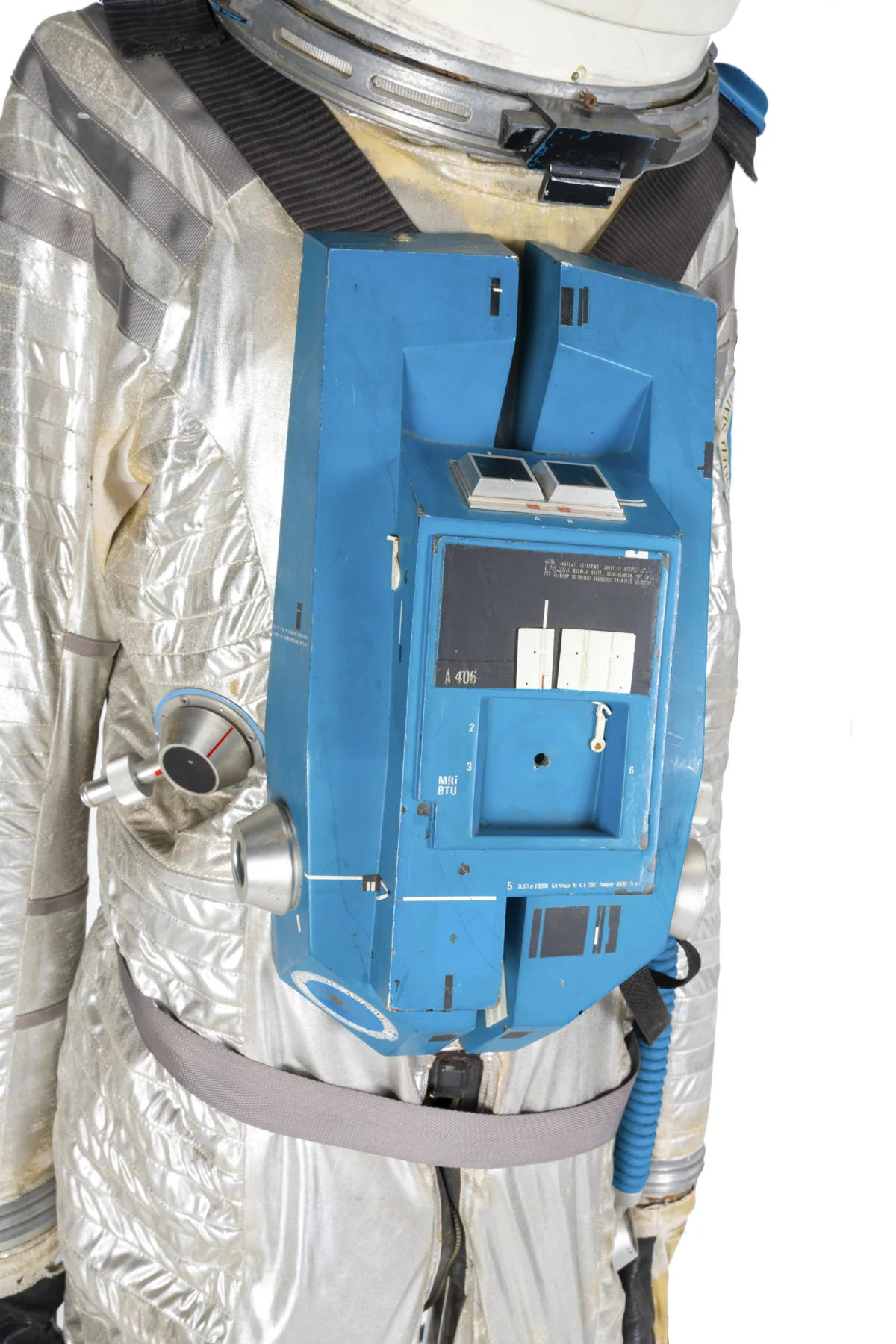
A nearly complete spacesuit worn in Stanley Kubrick’s masterpiece, 2001: A Space Odyssey (MGM, 1968), which won many Academy Awards and is regarded as one of the most important films ever produced.
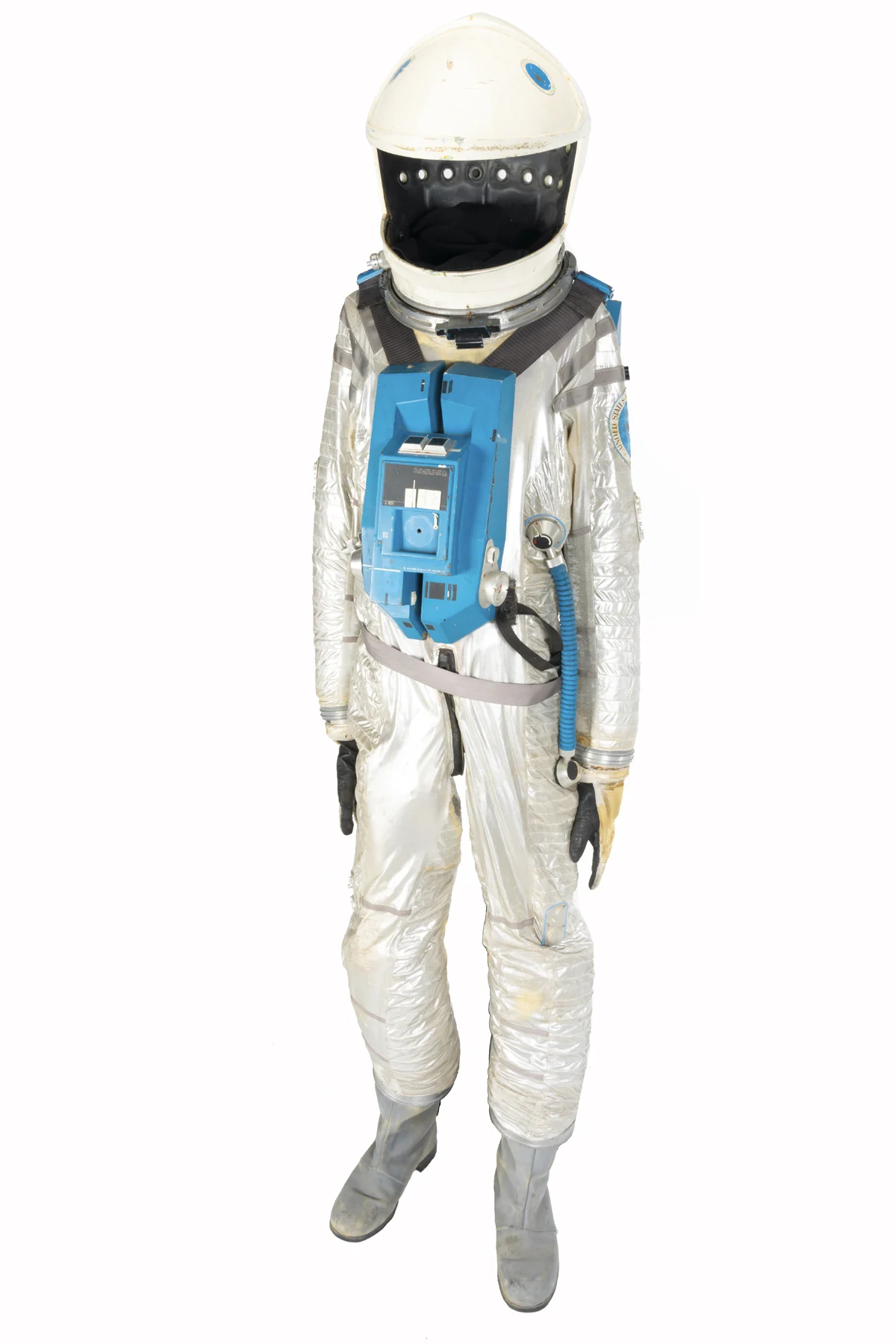
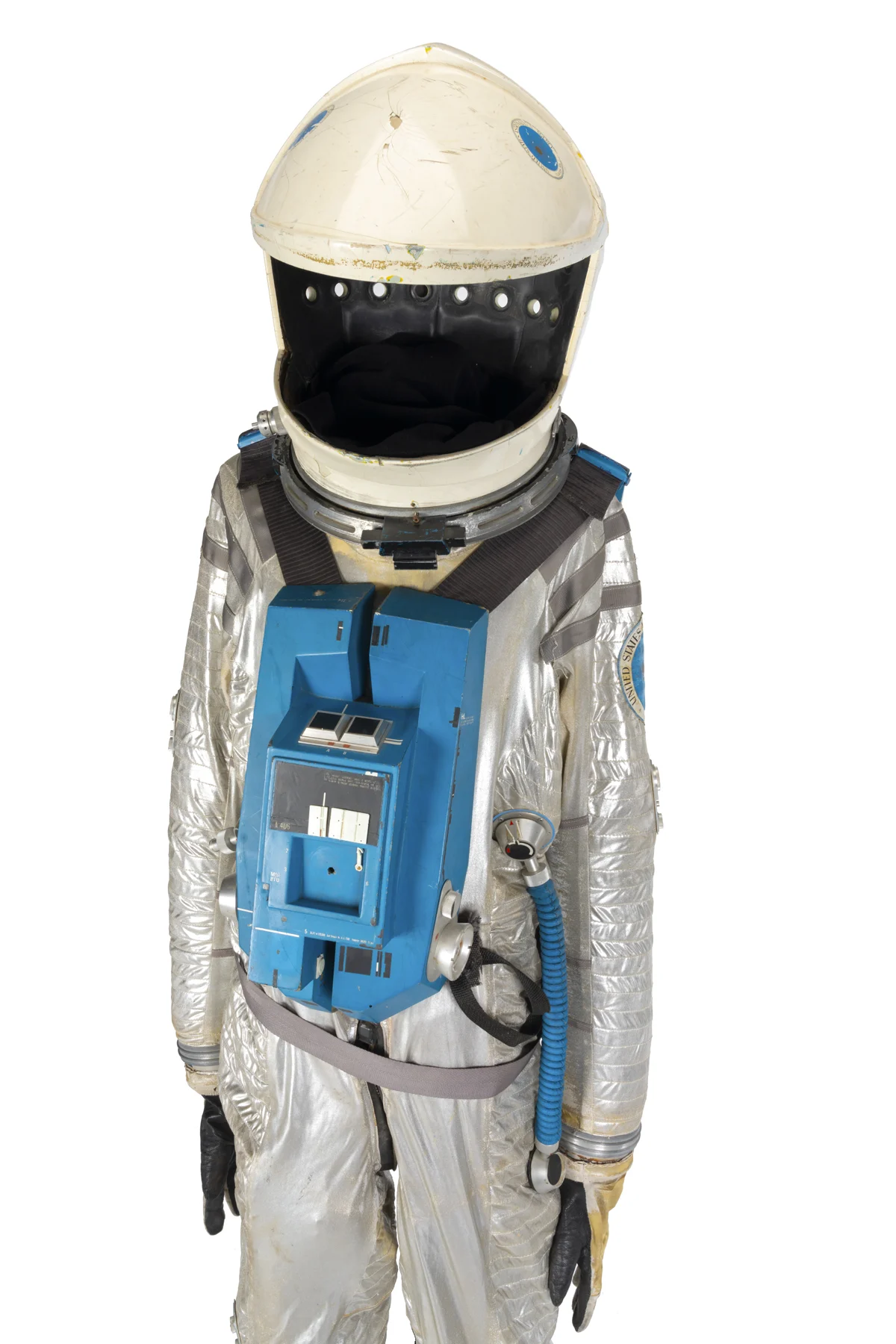
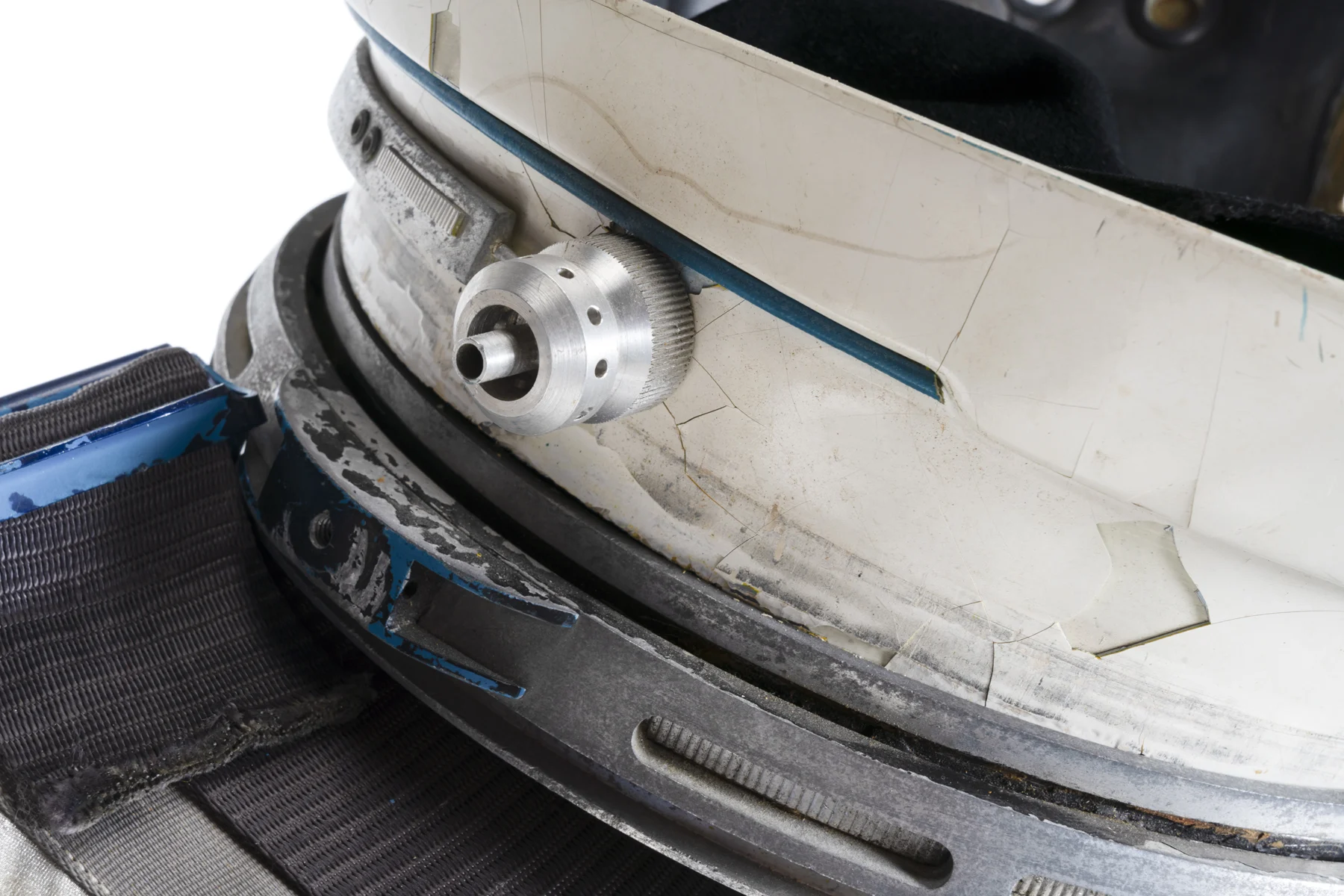
The spacesuit is an amalgamation of components worn by different actors and in many scenes throughout the film. This is highlighted by a helmet featuring four distinct layers of paint (a base of color of white, then green, then yellow, and lastly in its present color of white), indicating that it was used in different scenes by multiple actors and representing a number of characters . This nearly complete costume is of the lunar type in its present state (silver body suit, blue back pack, white helmet). This suit appears to be original in silver (never repainted). However, due to the layering of paint, the helmet appears to have been employed as a lunar type, then two of the four Discovery types (green and then yellow; the other colors/types being red and blue), then as a lunar type again. This helmet has a textured strip of tape inside with "HELMET A" written across in red.
Most notably, the base green layer of paint seen in chips, cracks, and green overspray throughout the helmet surface suggest that it may have been the very helmet worn by Keir Dullea, who portrayed Dr. Dave Bowman (the lead astronaut on the film’s Discovery mission to Jupiter) in the sequence in which he reenters antechamber of the Discovery surrounded by banks of circuit breakers leading to the "brain room" and logic center to “kill” HAL in one of the most famous science fiction scenes of all time ( "Stop Dave. Stop Dave. I am afraid. I am afraid Dave." ).
A memo from Stanley Kubrick to Arthur C. Clarke dated February 10th, 1966 (43 days after principal photography had begun on December 29, 1965) supports the timeline for the helmet in this auction to have been worn by Keir Dullea in the scenes described above with the green painted helmet. In the dictated memo, Kubrick opens, "I think I've figured out a completely believable way to get Bowman into the airlock" and described the action and physics of the scene.
Keir Dullea’s Dr. Dave Bowman is the only character to wear a green helmet in the film, and only in that sequence.
A yellow suit and matching helmet was worn by Gary Lockwood as Dr. Frank Poole as he is left floating into space.
Some helmets were reused and repainted throughout the production, with colors featured in the Discovery crew scenes (red, yellow, blue, green) and with white used on the lunar suits. The chest boxes for the lunar suits were also different from the Discovery crew examples, and the blue chest box in this lot matches the lunar suits, as does the silver jumpsuit. This jumpsuit that is part of this lot appears to have only been silver (not any other colors).
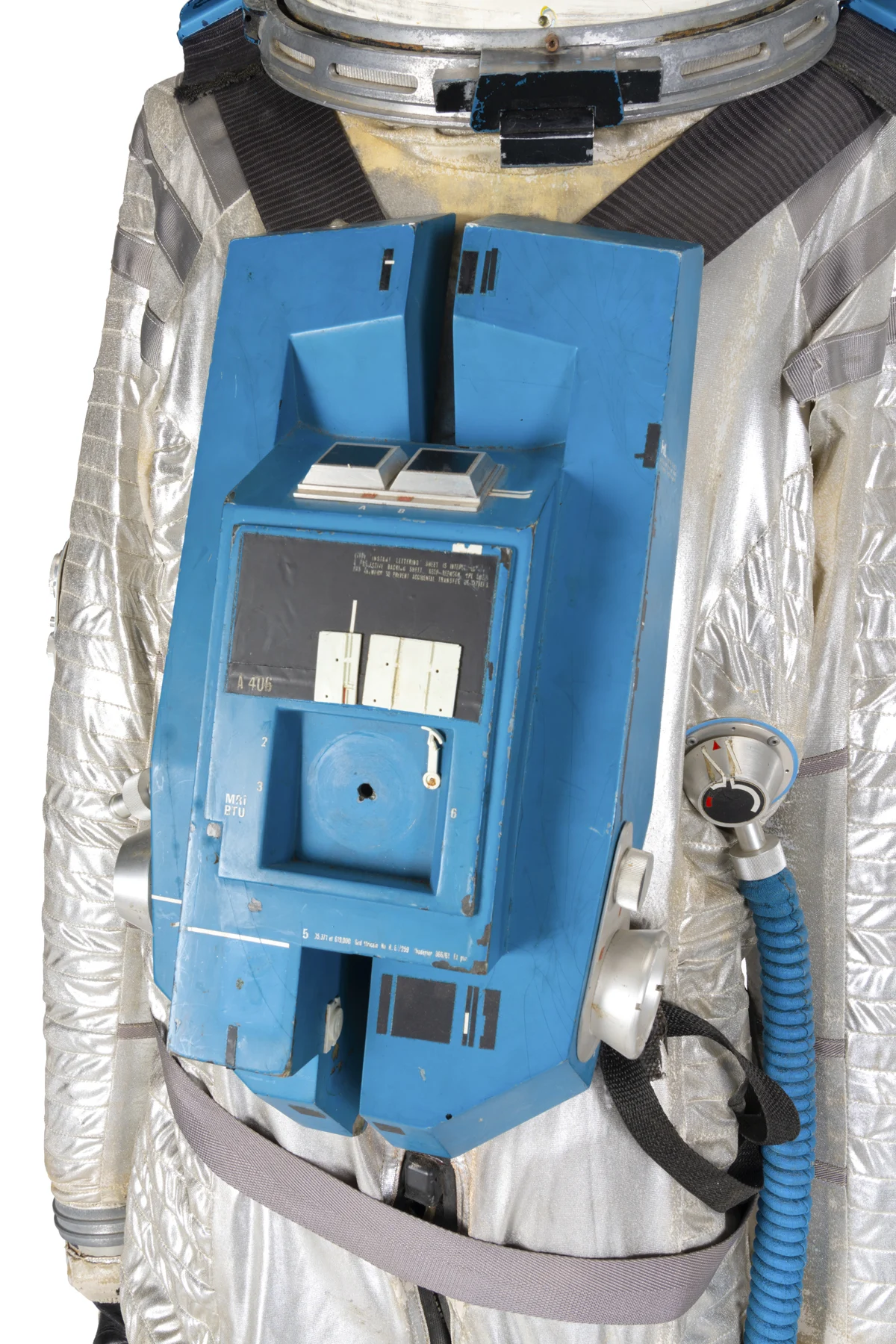
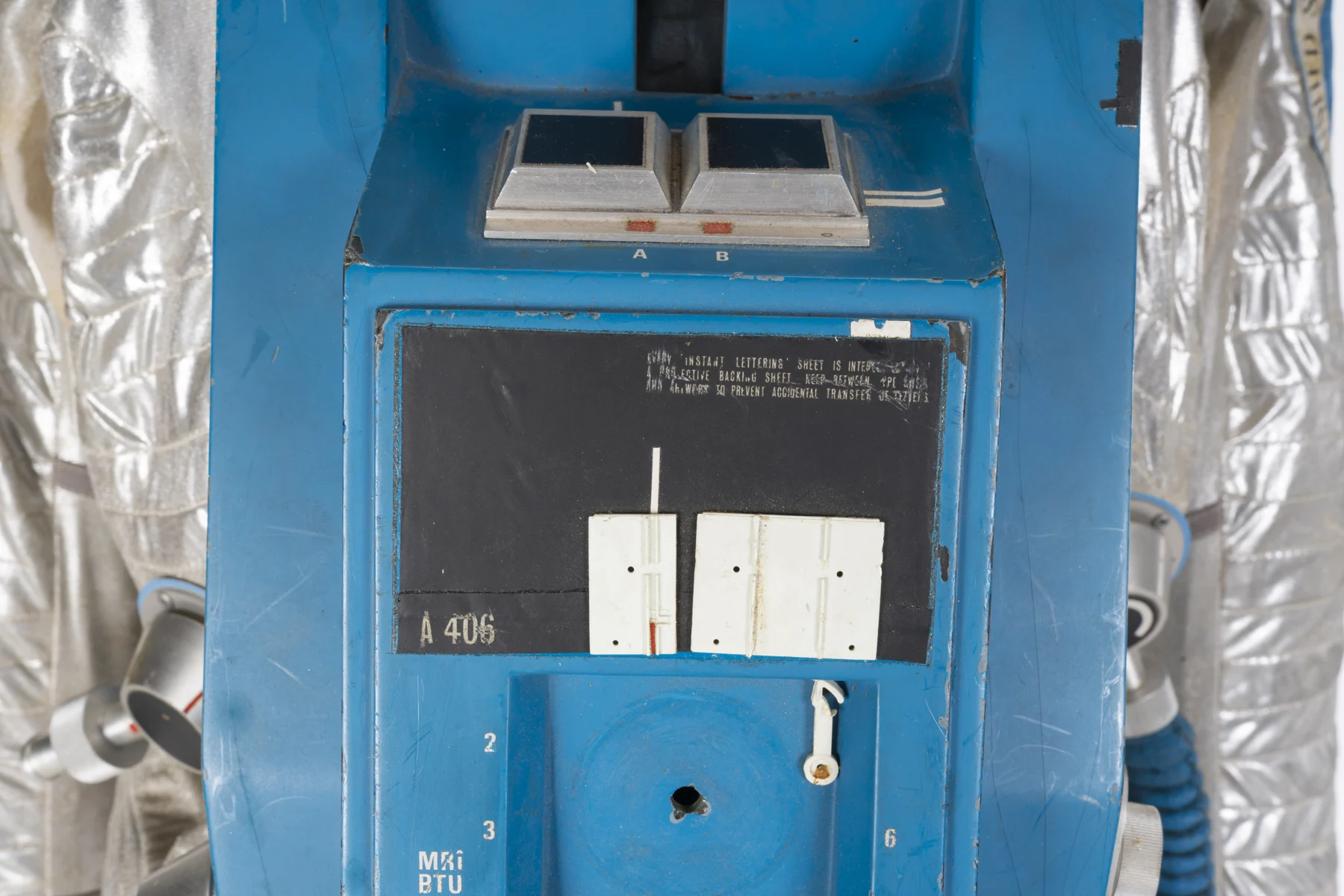
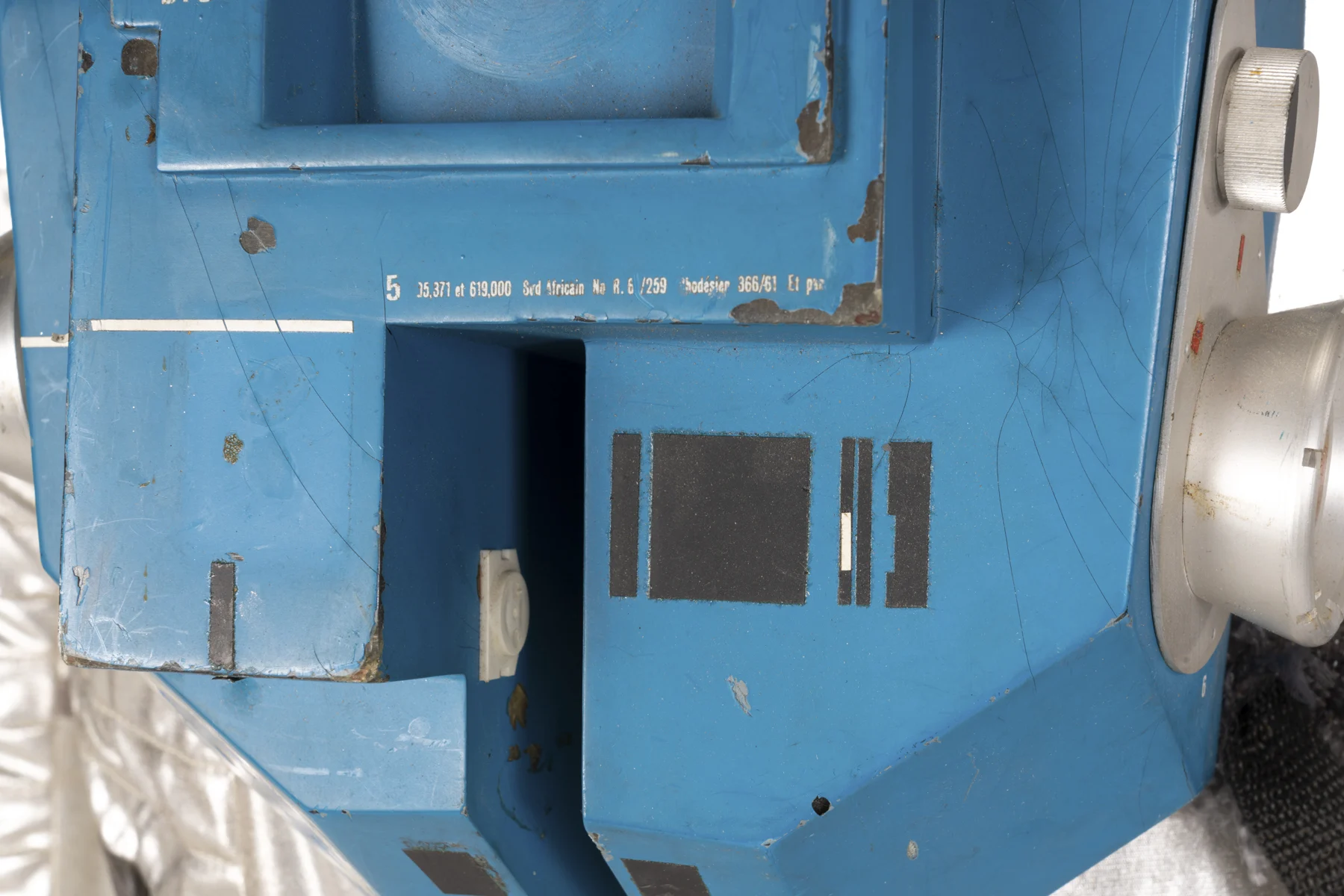
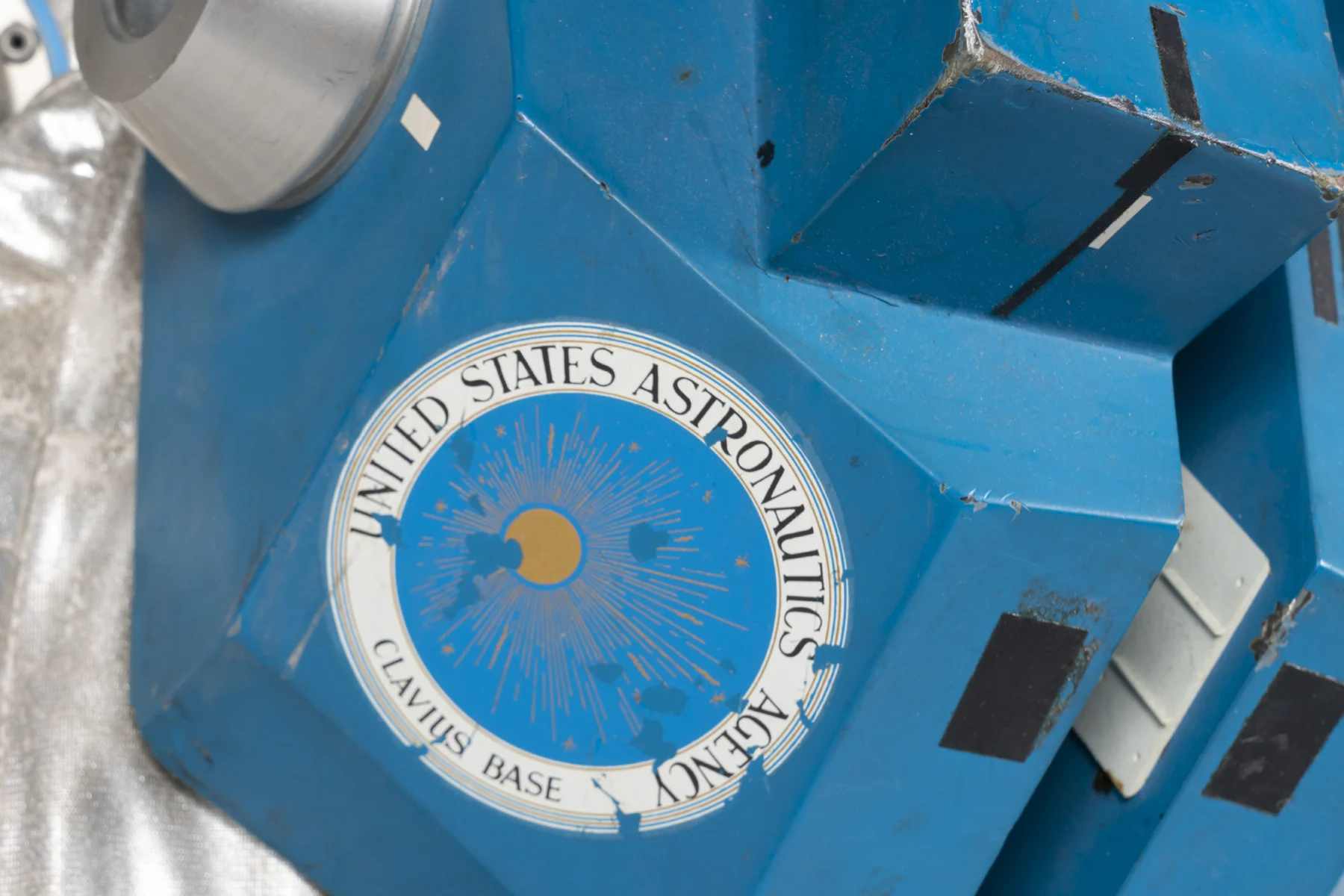
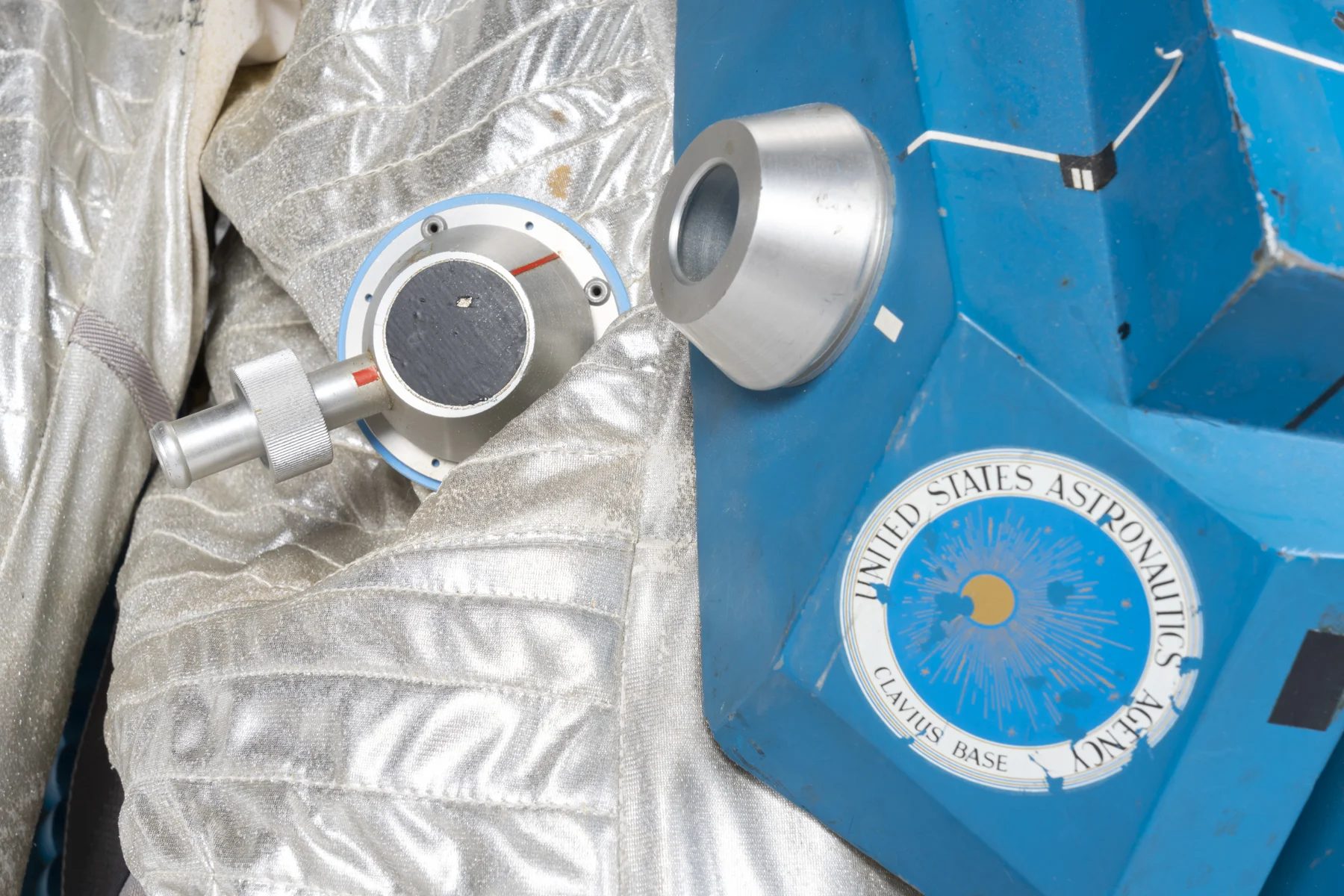
The lunar spacesuit consists of reflective silver cloth one-piece spacesuit coveralls with “United States Astronautics Agency Clavius Base” logo shoulder patches, inner ribbing at forearms and calves, metal helmet mount at neck, several valves with two blue ribbed rubber air hoses (one is loose), back-length rear zipper with Velcro back cover flap, and typed internal costume label; molded white space helmet with two “United States Astronautics Agency Clavius Base” decals, pleather internal lining over foam padding, with separate molded white inner cap; fiberglass and wood back and chest “life-support” packs with shoulder and midriff straps; a pair of gloves; a pair of boots; an audio headset with four earpieces; and a buckle. Also included is a vintage wood base and wood shipping crate addressed to “Mr. Emery Austin, MGM Inc., 1350 Avenue of the Americas, New York, N.Y. 10019, U.S.A.” with various notations including its dimensions, weight, “Case No. 5,” and “Spacesuits, From J. Korsak, 1-20-69.”
The silver jumpsuit portion of this costume is one of the group of similar silver suits worn by the astronauts in the pivotal scene where they approach and touch the alien black monolith, “TMA-1,” in the lunar crater Tycho. These suits also appear during the scenes of the astronauts traveling to the crater aboard the Moon Bus shuttle.
2001: A Space Odyssey marked a quantum leap in the realistic depiction of space travel in films largely due to Kubrick’s meticulous pursuit of accuracy in the film’s projections of near-future astronautical vehicles and equipment. Alongside his production team of experienced filmmaking personnel, Kubrick hired astronautical experts Fred Ordway and NASA veteran Harry Lange (1930-2008); it was Lange who created the essential designs of the film’s spacesuits, spaceships, and other hardware.
A standard movie production designer would have lacked Lange’s extensive background in astronautics, which helped ensure that Kubrick’s space voyages would not be rendered obsolete by the real moon trip NASA was rapidly developing.
Lange’s spacesuit designs included flexible, accordion-style joints, which were partially drawn from similar concepts at NASA. The painstaking attention to detail on the suits is vividly apparent in the tiny, yet readable, text throughout the suit’s life-support unit - details that barely registered on screen. A foundation of his designs was based around NASA's "constant volume" principal, with horizontal stitching within the fabric preventing the space suits from ballooning when inflated.
The suit itself was made by Frankenstein and Sons of Manchester, United Kingdom; the helmet and life-support packs were made by Master Models (London). Lange received a BAFTA Award in 1968 for Best Production Design for 2001: A Space Odyssey and an Academy Award nomination in the same category. He continued working in films after 2001: A Space Odyssey , including the original Star Wars trilogy.
This particular spacesuit appears to have been assembled decades ago from parts of several of the film’s identical suits.
The boots have the internal notation “T&H, Size 9, W. Sylvester,” referring to actor William Sylvester, who played Dr. Heywood Floyd, the scientist who actually touches the film’s alien Monolith.
The main suit has a typed label under its Velcroed back flap reading “2001- A Space Odyssey, R. Beatty”, for Robert Beatty who played Dr. Ralph Halvorsen in the movie.
The life-support backpack has “J. Swindells” written inside, referring to actor John Swindells, who appears (uncredited) as a technician.
Although this costume is nearly complete, it is missing only a few pieces: the helmet’s clear visor, several small plates from the helmet’s rear “memory unit” (two plates are present), and a centrally mounted piece from the front life-support pack.
Several of the controls on the life-support backpack have come loose, but are present, and two of the other controls are missing.
Interestingly, the boots’ treads have gravel and wood chips stuck in them, possibly remnants of the Tycho Crater set.
The suit comes with a shipping crate mailed from England to the studio’s New York offices, addressed to Emery Austin, MGM’s assistant director of advertising and publicity.
Austin specialized in overseeing publicity for special “roadshow” engagements of MGM’s more lavish films, including 2001: A Space Odyssey , which played in certain special venues in the immersive Cinerama process.
Although the exact purpose of shipping the costume is uncertain, it appears that this suit and possibly other 2001: A Space Odyssey costumes were planned for display at prominent theaters or otherwise used as part of the film’s massive publicity campaign.
Historical records and memos reference a potential exhibition at the National Air and Space Museum of the Smithsonian Institution for a world premiere in Washington, D.C., as well as a space exhibition themed to 2001: A Space Odyssey with NASA, IBM and the University of Utrecht for the lobby of the Rotterdam Cinerama. However, no evidence exists that either of these plans came to fruition.
The notations on the crate indicate that this was one of a group of five packages, and the date marked on it, January 20, 1969, is nine months after the film’s world premiere in Washington, D.C., on April 2, 1968.
Notably, a January 15, 1969, Variety article announced that Emery Austin was retiring from MGM after a career spanning 41 years.
This costume was purchased at auction by the current consignor in 1999, and it has been in climate controlled storage for the past two decades.
2001: A Space Odyssey remains one of the most important and influential science fiction films of all time, and screen-used props and costumes from it are extremely rare and almost never come up for auction. Legend has it that some production assets were destroyed following wrap on production and/or disposed of at a later date. They are among the most sought after and desirable of science fiction film artifacts, and this represents the first opportunity in the past twenty years to purchase at auction a genuine and nearly complete 2001: A Space Odyssey spacesuit.
BIDDING ON THIS LOT REQUIRES SPECIAL REGISTRATION REQUIREMENTS
Please contact info@juliensauctions.com or call (310) 836-1818 for additional information to bid on this lot.
Provenance
Lot 247, Sotheby’s “Collector’s Carousel” Auction in New York on June 12, 1999