Julien's Auctions · Sale 353 · Lot 871
CHRISTOPHER REEVE WIRE AND ZOPTIC "FLYING & MECHANICAL" CAPE WORN IN SUPERMAN, SUPERMAN II
Photographs: © Julien's Auctions
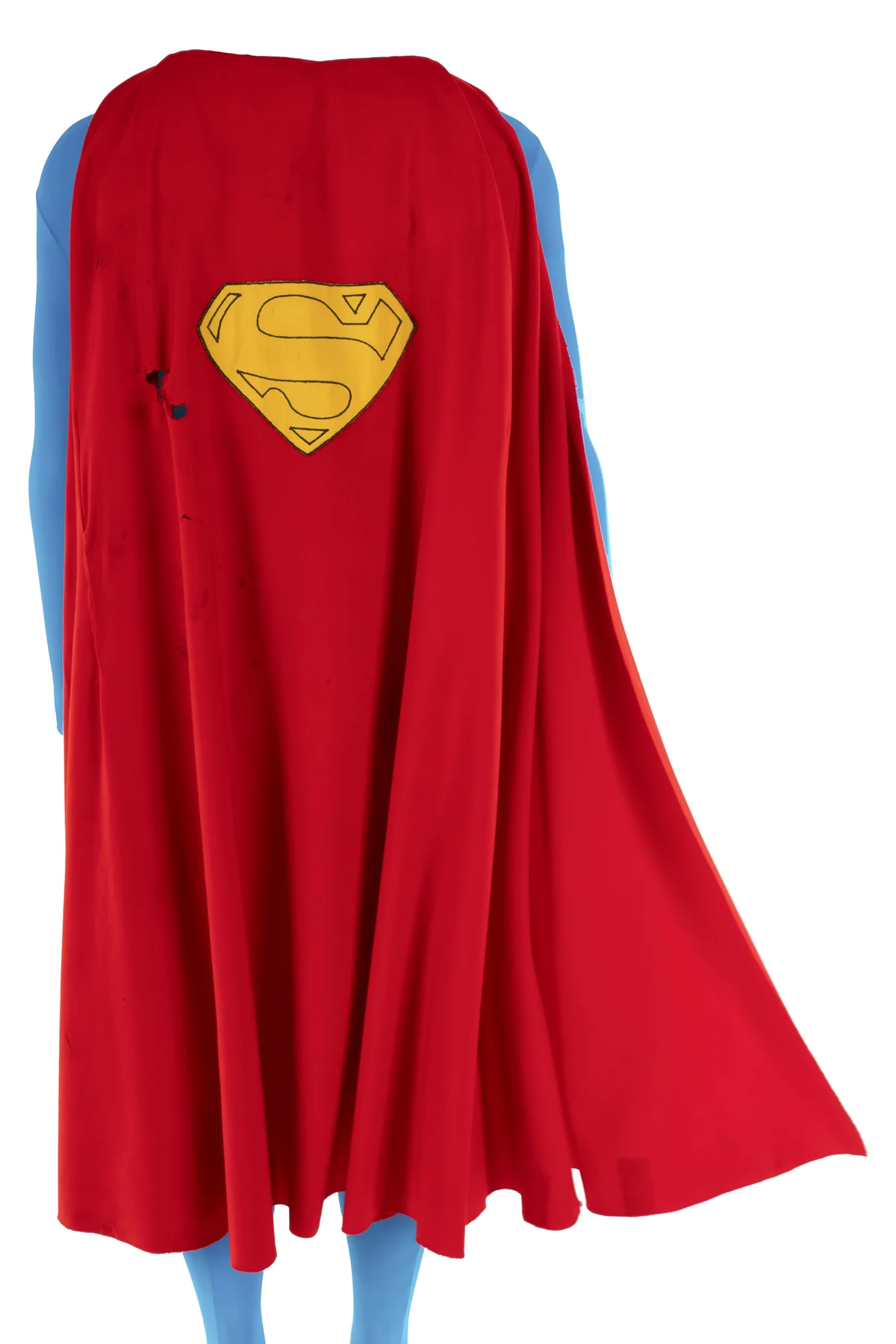
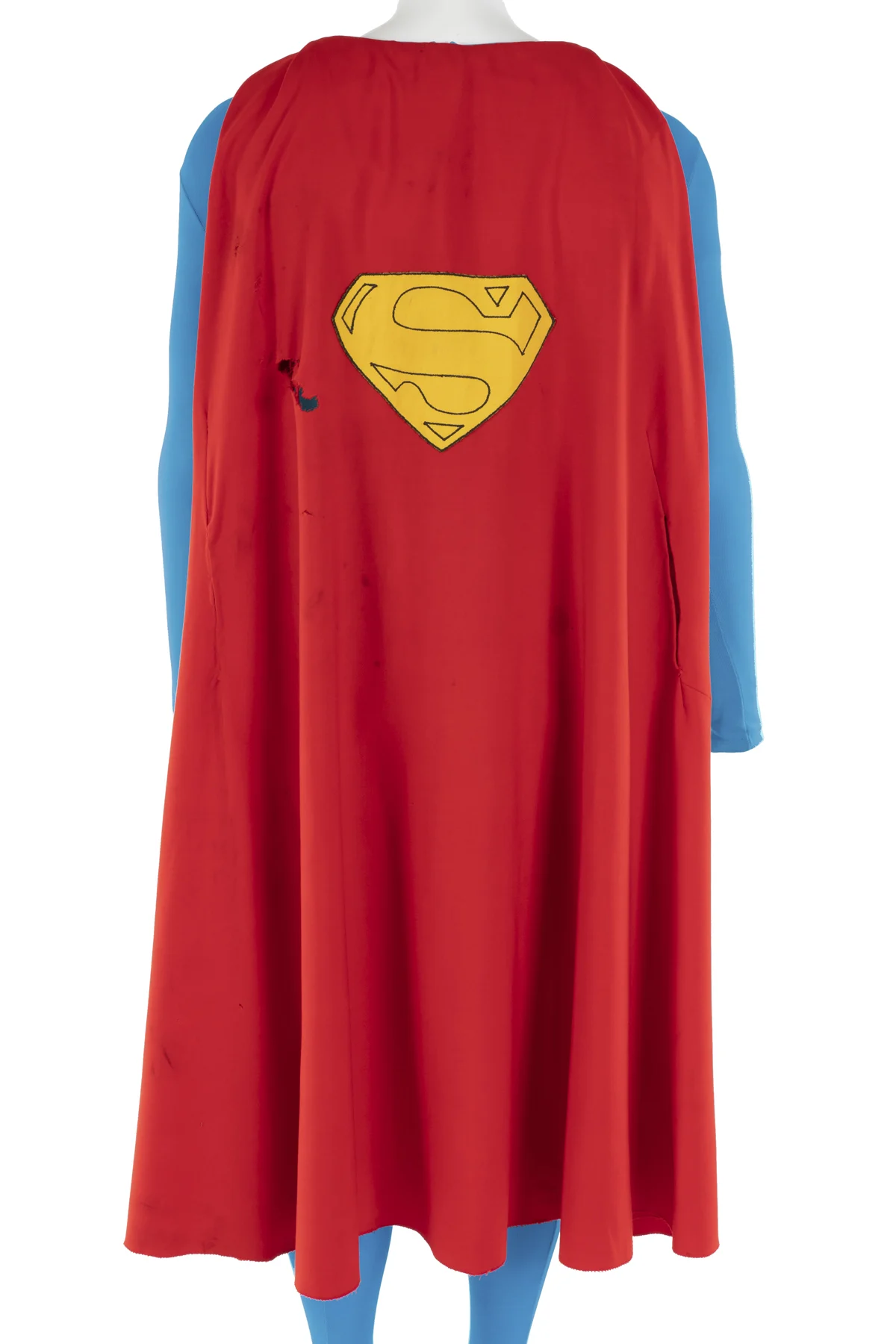
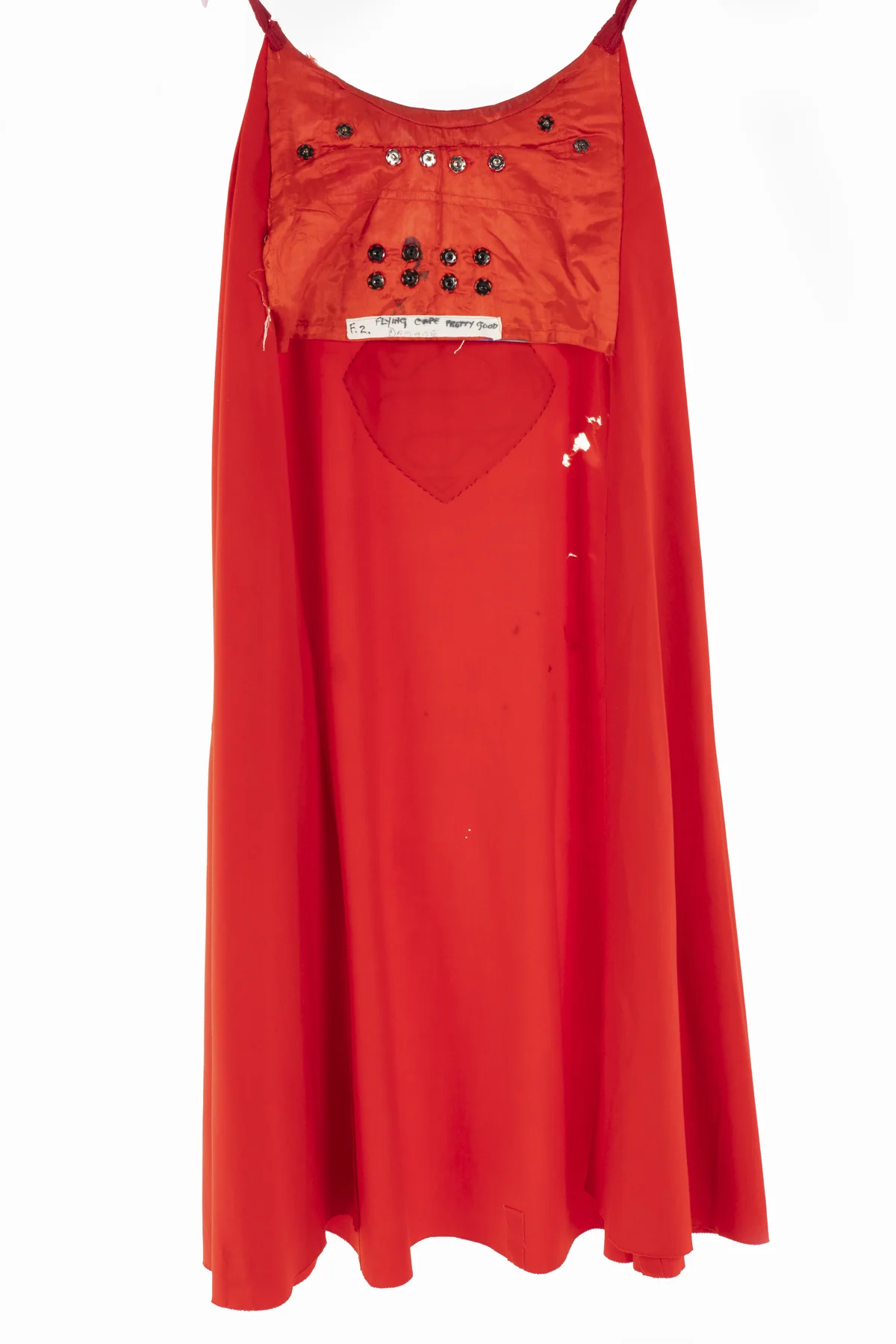
An original cape worn by Christopher Reeve in Superman (Warner Bros., 1978) and Superman II (Warner Bros., 1980) and possibly Superman III (Warner Bros., 1983). Primarily used for both studio blue screen traveling matte wire flying and studio ZOPTIC front projection flying.
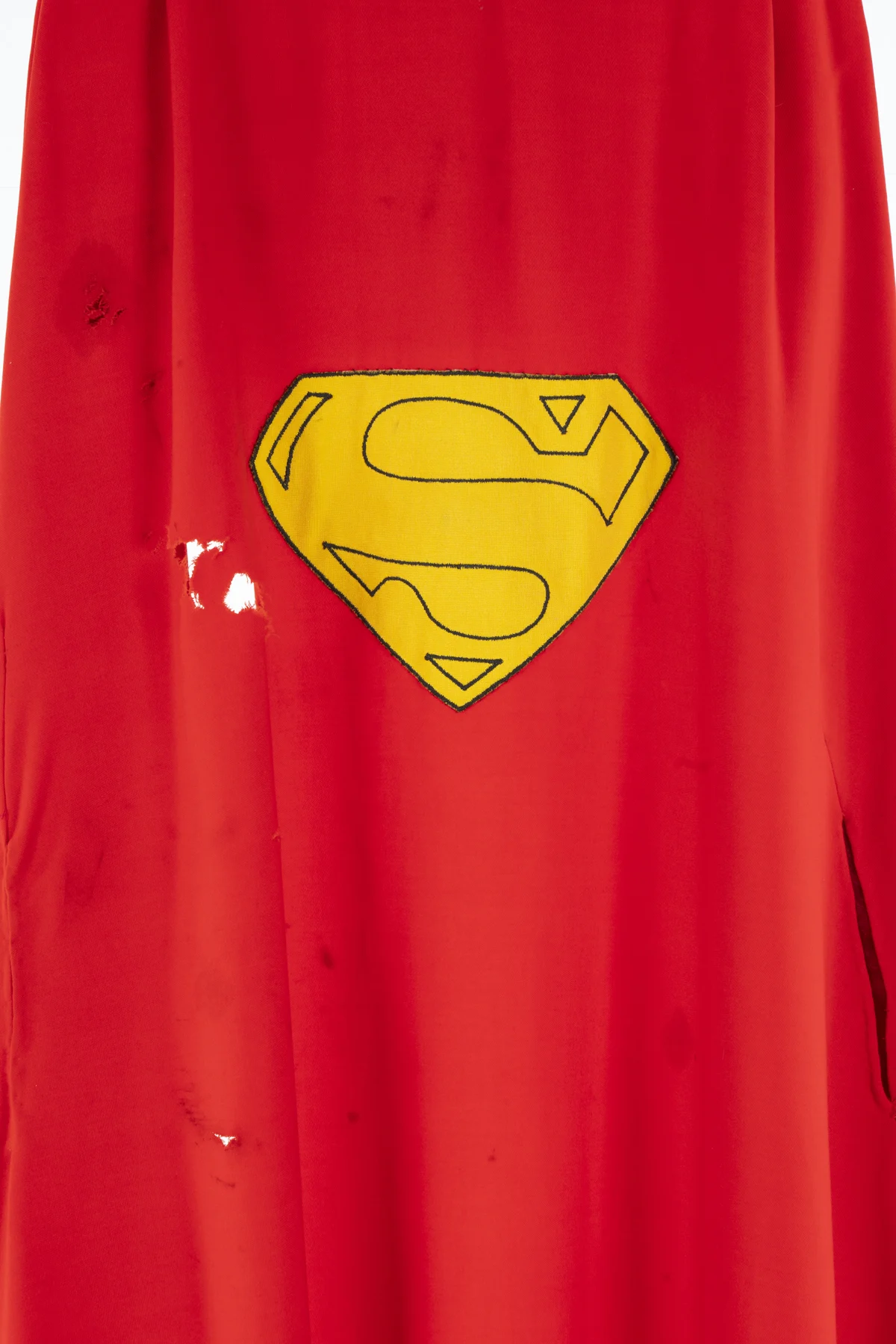
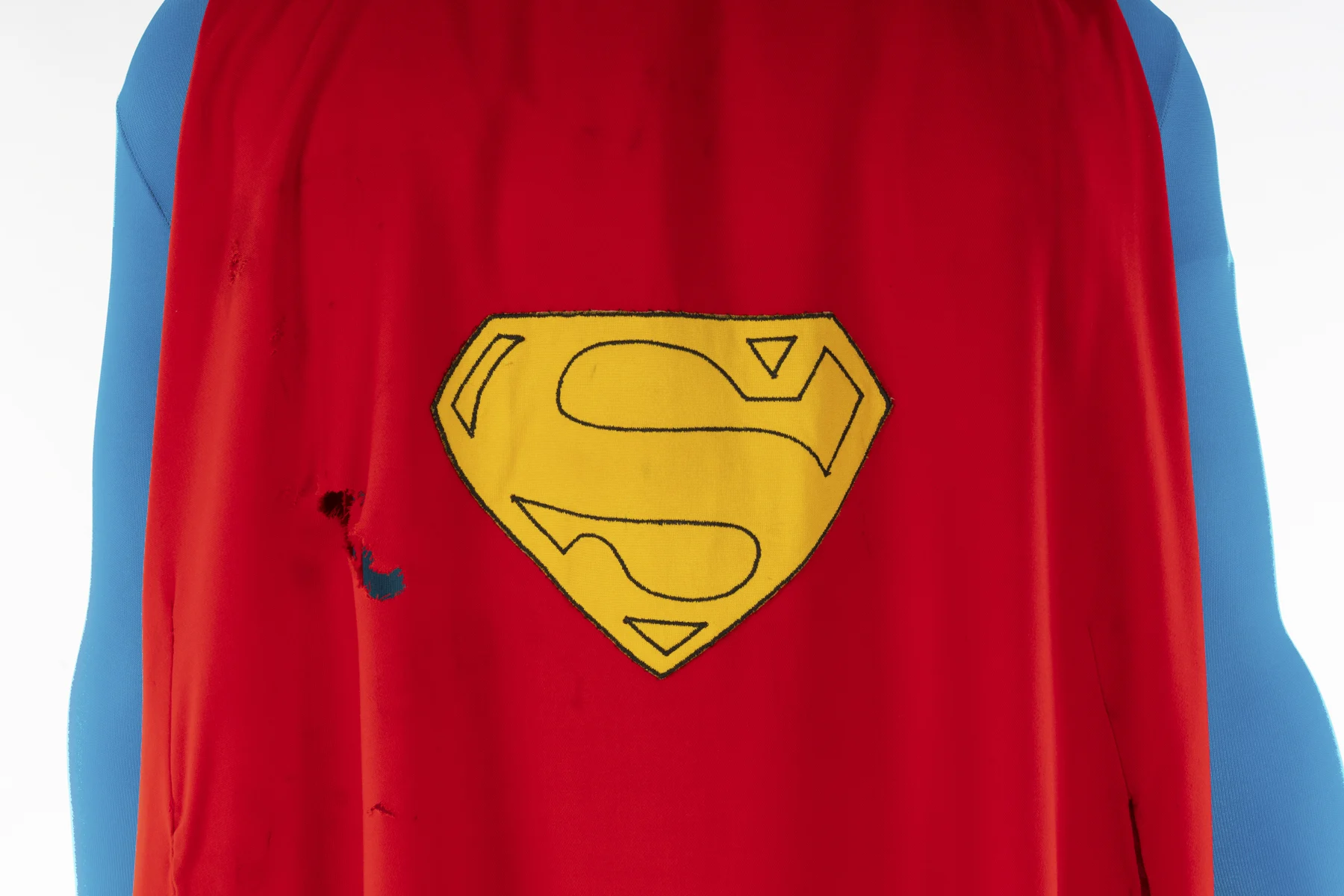
Bright red cape with iconic yellow “S” symbol shield outlined in black, stitched to back. The yellow “S” shield has little to no yellow outside of the outer black border (consistent with the “Contest” cape sold by Julien’s in December 2019), which would indicate that it is likely a cape that was originally created for the first two films (filmed simultaneously) and may have also been used in Superman III .
The cape features red cloth ties at neck with padding at top.
Two sets of black snaps on either side of shoulder area with four horizontal silver snaps between. Directly below, two additional rows of four black snaps with a thick black felt-tip marker “2” written over and a “3” below the snaps (subsequently crossed out) and fainter “2” to the right. Directly below, felt-tip black ink handwritten costume tag reads “F.2. FLYING CAPE PRETTY GOOD DAMAGE.”
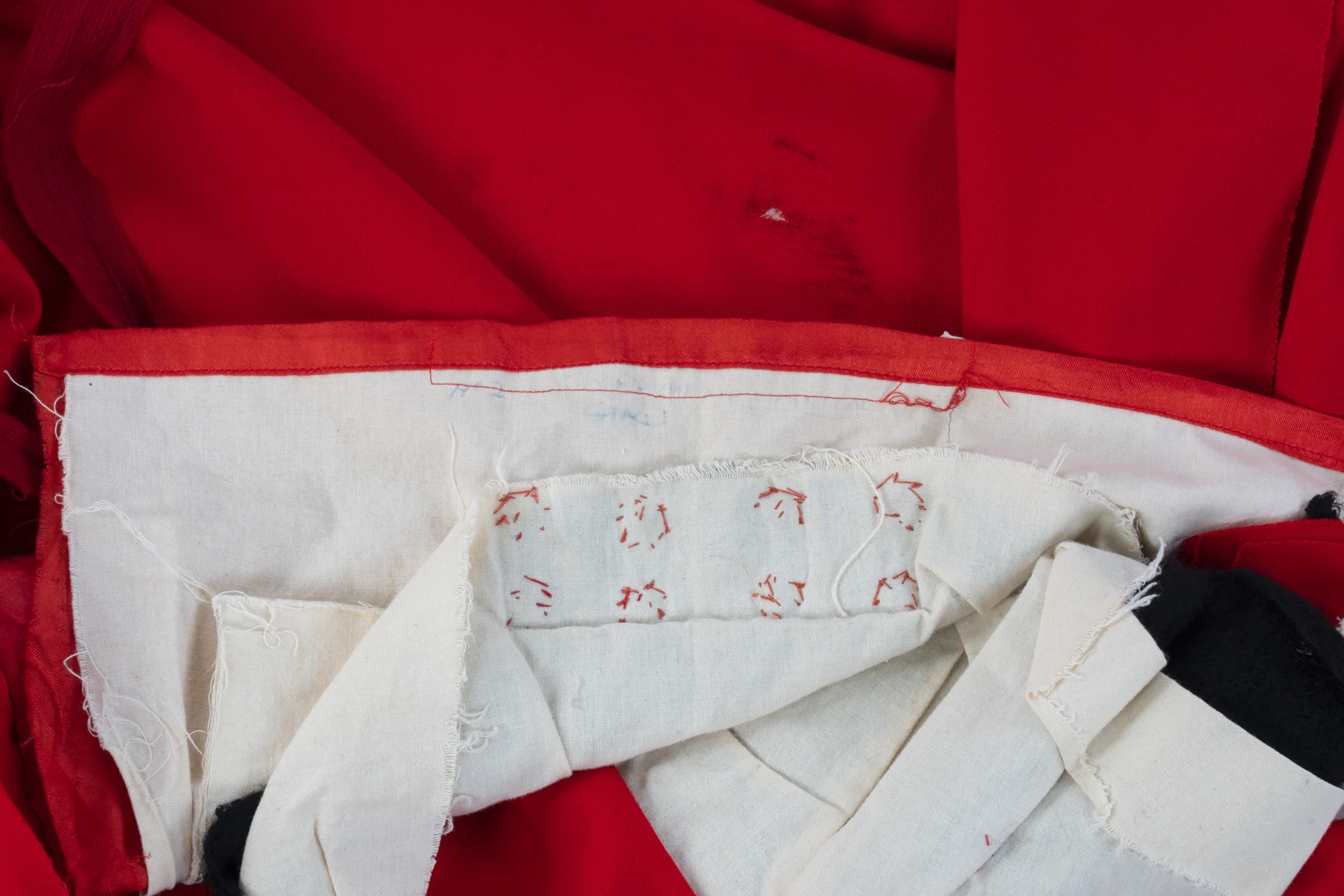
Faint ballpoint writing under the flap below the inside neck area appears to read “M2 FLYING AND MECHANICAL” with another line below that is now difficult to decipher due to fading.
Two stitched slits closed with Velcro are positioned part way down either side of the cape. Across the entire bottom are seven pouches (one missing; originally a total of eight) evenly spaced, closed on all sides except open at top.
This is a unique style of cape that was employed for at least two different flying effects and uses across what we believe to be the first three Superman films.
The cape was originally designed for flying scenes, as evidenced by the two Velcro slits at the sides so that two wires could attach to a harness hidden under the costume.
It appears that the cape was subsequently designed for the radio-controlled “flapper” device that was secured to Reeve’s back. The additional black metal snaps would have been used to secure the device to his back. The metal rods protruding from the flapper device would fit into the pockets at the bottom of the cape. An operator could then use the device to manipulate the cape with the rods to create the illusion of the cape flapping and fluttering (even in the absence of natural or artificial wind) to make a more convincing flying effect.
Based on historical production articles about the Superman films, the cape flapper device was used during front projection ZOPTIC studio flying scenes in which the actor lays in a horizontal position in a body pan as well as with scenes in which the actor is suspended on wires in front of a bluescreen inside a sound stage and connected to a harness hidden under the costume (which would utilize the two Velcro slits). The cape flapper may have been used when Reeve was moving on wires connected to a large crane outdoors, although it is believed to have been an infrequent occurrence.
Per the Superman cover feature in the January 1979 issue of American Cinematographer :
When wind machines failed to solve the problem of making Superman’s cape swirl realistically while flying in front of the ZOPTIC front-projection process screen, Les Bowie invented a device with radio-controlled rods to make it happen.
Les Bowie (Creative Supervisor of Mattes & Composites, Superman ):
I saw at the very beginning that there was going to be a hell of a problem with Superman’s cape, because it meant that wherever he went you had to have a huge wind machine, so I thought it would be a very good idea if we made his cape flap up to look as if it was being blown by the wind, but to do it by means of sort of motorized fishing rods, operated by radio control. He carried the batteries. Everything went with him, but we could vary the speed by radio control.
Colin Chilvers (Creative Supervisor & Director of Special Effects, Superman ):
The problem of making his cape swirl out as though he were flying was one for which Les Bowie finally came up with the answer. It was basically a mechanical system that Christopher Reeve used to wear in his costume to make the cape flap. Otherwise, because there were so many attitudes in which you wanted Superman to fly, you would have had to completely rig his area with wind machines. However, wind machines are something over which you don’t have much control, because a bladed wind machine tends to turn the air, rather than give you a straight blast. But they are the strongest wind machines; you cannot get a linear fan that will give you the same sort of output as a bladed fan.
In the beginning the problem (using just wind machines) was that the cape used to swirl underneath Superman’s body, but the refined and radio-controlled rig that we built (as per Les’s ideas), when combined with the wind, worked out reasonably well. The cape-swirling device was battery-powered, which meant that it could be used under any conditions, whether he was flying outside at night on the back lot supported by wires, or on the stage with the hydraulic rig. It was completely self-contained within the body pack that he wore.
Additional research provided by Jim Bowers, Editor, CapedWonder.com