Julien's Auctions · Sale 333 · Lot 150
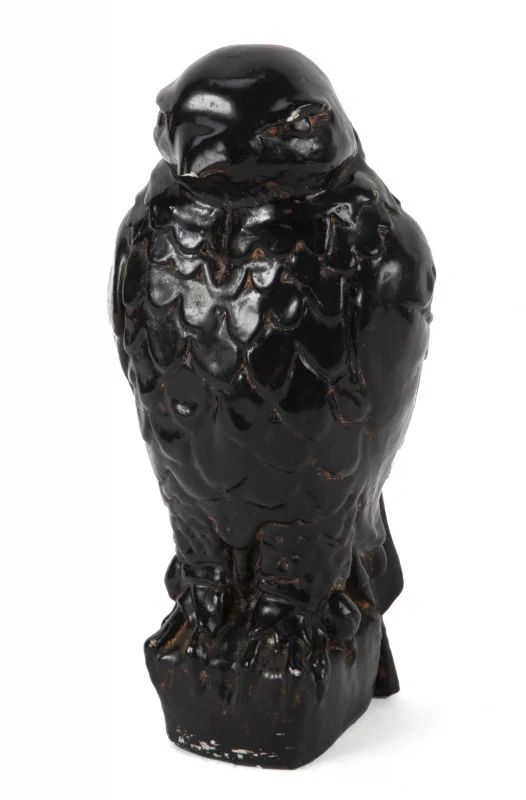
MALTESE FALCON STATUETTE FROM THE WARNER BROS. PROP DEPARTMENT
Photographs: © Julien's Auctions
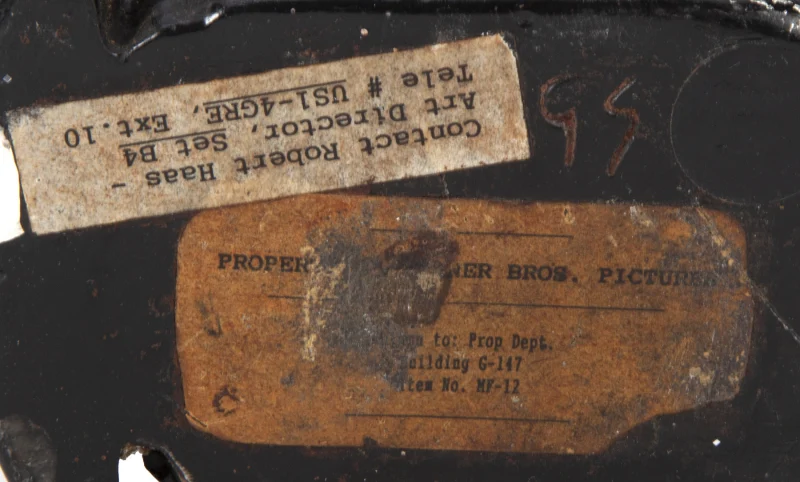
A cast plaster falcon (painted black) with vintage paper labels adhered to the base. The statuette varies in style considerably from the ones used on screen in the iconic film The Maltese Falcon (Warner Bros., 1941), but the labels on the base of the statuette link it directly to the studio and the art director for the film, Robert M. Haas (1889-1962). The first label, applied to the base before the bird was painted, reads “Property of Warner Bros. Pictures/ Return to: Prop Dept./ Building G-147/ Item No. MF-12.” The second label, applied after the first and after the application of the black paint, reads “Contact Robert Haas / Art Director, Set B4/ Tele # US1 4GRE, Ext. 10.” Additional inscribed marking on base appears to be a difficult to discern “gs” or “95.”
The production history of the falcons created for both the 1941 film and the subsequent 1975 spoof The Black Bird (Columbia, 1975) has been studied and analyzed for decades with limited consensus among collectors and scholars. The number of statuettes that were created by prop department employees, not only for the film productions but also subsequent to the production, is a subject of great mystery and speculation. It is known that the Warner Bros. prop department retained the mold used to create the original statuettes that appeared on screen in the 1941 film as well as publicity images for the film. The exact number of statuettes that were created using the mold at this time is impossible to determine given the absence of production records. We do know that after the success of the film in 1941, plaster casts were created by the prop department. Some have reported that Jack Warner gave copies of the falcon as gifts to those who admired the statuette that at one time sat perched on his desk. Other rumors have circulated about enterprising prop department employees in the 1940s who also made casts from the molds and had an illicit side business selling replica statuettes to interested fans of the film. All of these rumors are impossible to prove with any degree of certainty given the fact that 78 years have passed and the employees involved at that time are no longer available to set the record straight.
What is very clear, when comparing this falcon to those used in both the 1941 and 1975 films, is the fact that it varies in style and detail from both the recessed and raised feather versions. This statuette has a distinctive vertical line running down the back through the tail feathers not seen in other examples; this bird has much smaller eyes, it has a very abrupt transition from head to shoulders with no feathers on the sides of the head, its feathers are not as raised as those on the later 1975 birds but not as recessed as those from the 1941 film. The talons of this bird extend over the base farther than others, the brow ridge above the eye does not extend to the back of the head, and the shoulders are more rounded rather than broad like other examples. Overall, the casting of this bird is not as crisp as other examples and appears to have been made from a mold that was either an early unrefined prototype or it was cast from a later generation mold that has been altered and/or has lost detail.
The labels on the base of this statuette are the only clues to the origin of this falcon. Whether placed there by prop department employees in the 1940s to convince potential buyers that the bird was somehow officially connected to the 1941 film or if the labels were genuine inventory control labels from the late 1940s, in either case, we believe that the aging and distress of the labels is genuine and that they have in fact been in place since that time. We know that Robert Haas had a very long career with Warner Bros., from 1929 until his retirement in 1950. We can, therefore, date this statuette to no later than 1950 since there would have been no logical explanation for a label with contact information for Haas on the studio lot after his retirement. It is also interesting to note that the adhered paper label for the Warner Bros. prop department on the base of the statuette lists this piece as “MF-12,” indicating that there were at least 12 copies of the bird in their inventory at that time, confirming the fact that there were a considerable number of birds made in the 1940s. If this bird is an early prototype cast from an unrefined mold or a hastily made copy from a much-degraded mold, it is still the only plaster copy that has ever surfaced with labels dating the bird to no later than 1950 and from the Warner Bros. prop department.
Dimensions: Height, 11 inches; chest circumference, 5 inches; base, 2 by 3 inches; weight, approximately 6.25 pounds